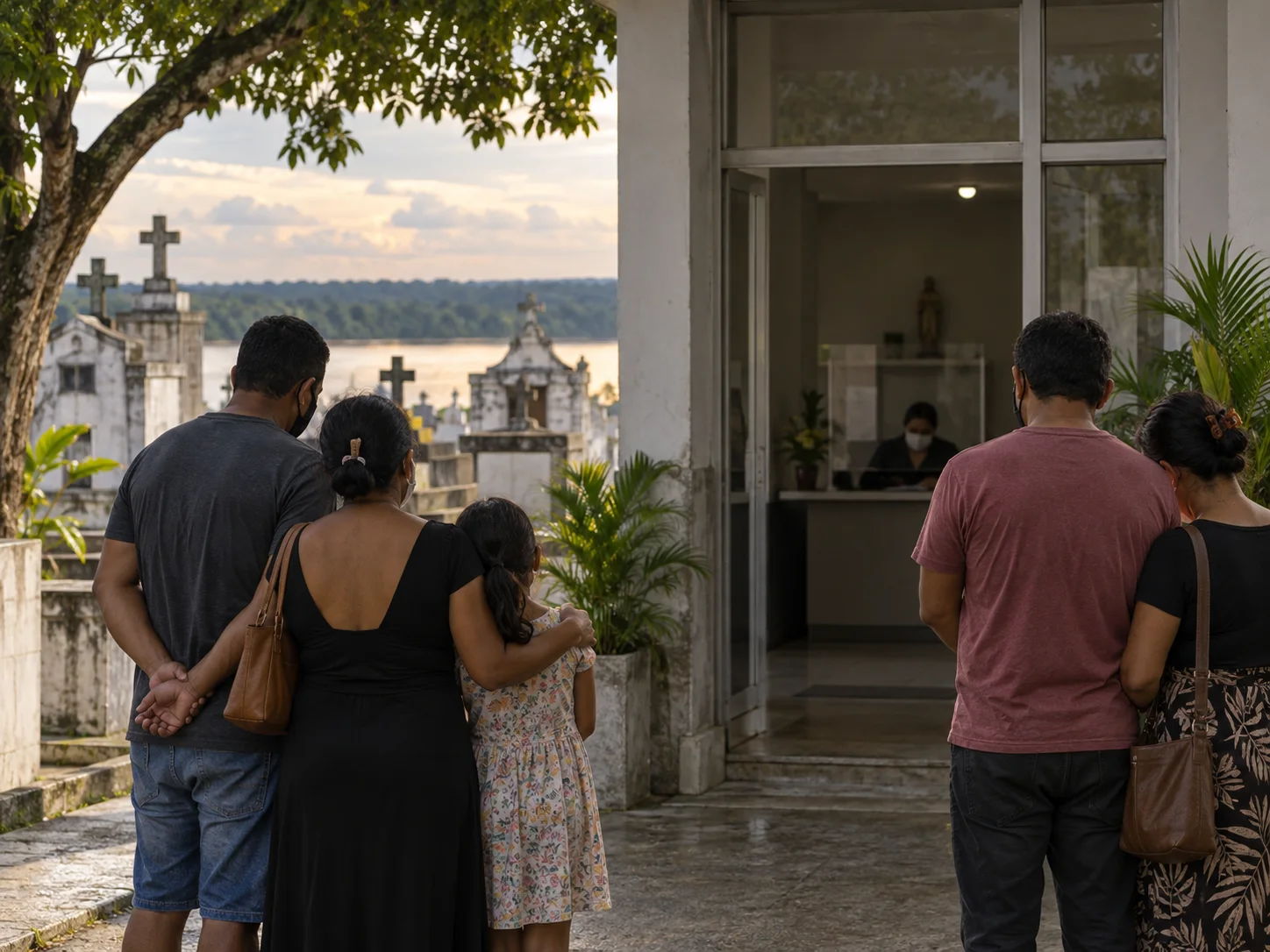
In April 2020, burial services in Manaus, Brazil, had to receive the dead faster than families could complete the ordinary rituals of farewell. Reuters reported that the city’s main cemetery was burying five coffins at a time in collective graves, while bodies accumulated in a refrigerated container used as a temporary morgue. Maria Garcia, whose 80-year-old grandfather had died at home after respiratory collapse, waited three hours in a line of hearses to obtain the death certificate required for burial. The vehicles in this queue carried families and coffins, not customers.
As intensive-care capacity disappeared, daily burials reportedly rose from a normal level of about 30 to more than 100 on some days. The cemetery opened a new section with rows of trenches to increase capacity. Yet the efficiency of “five at a time” also risked turning five individual deaths into a single unit of work. For a family, certification, transport and burial each imposed a separate wait, while grief remained irreducibly personal. This line should not be consumed as a bizarre pandemic spectacle. It is a record of hospital overload passing into the funeral system, until an administrative delay became inseparable from the time required to mourn.