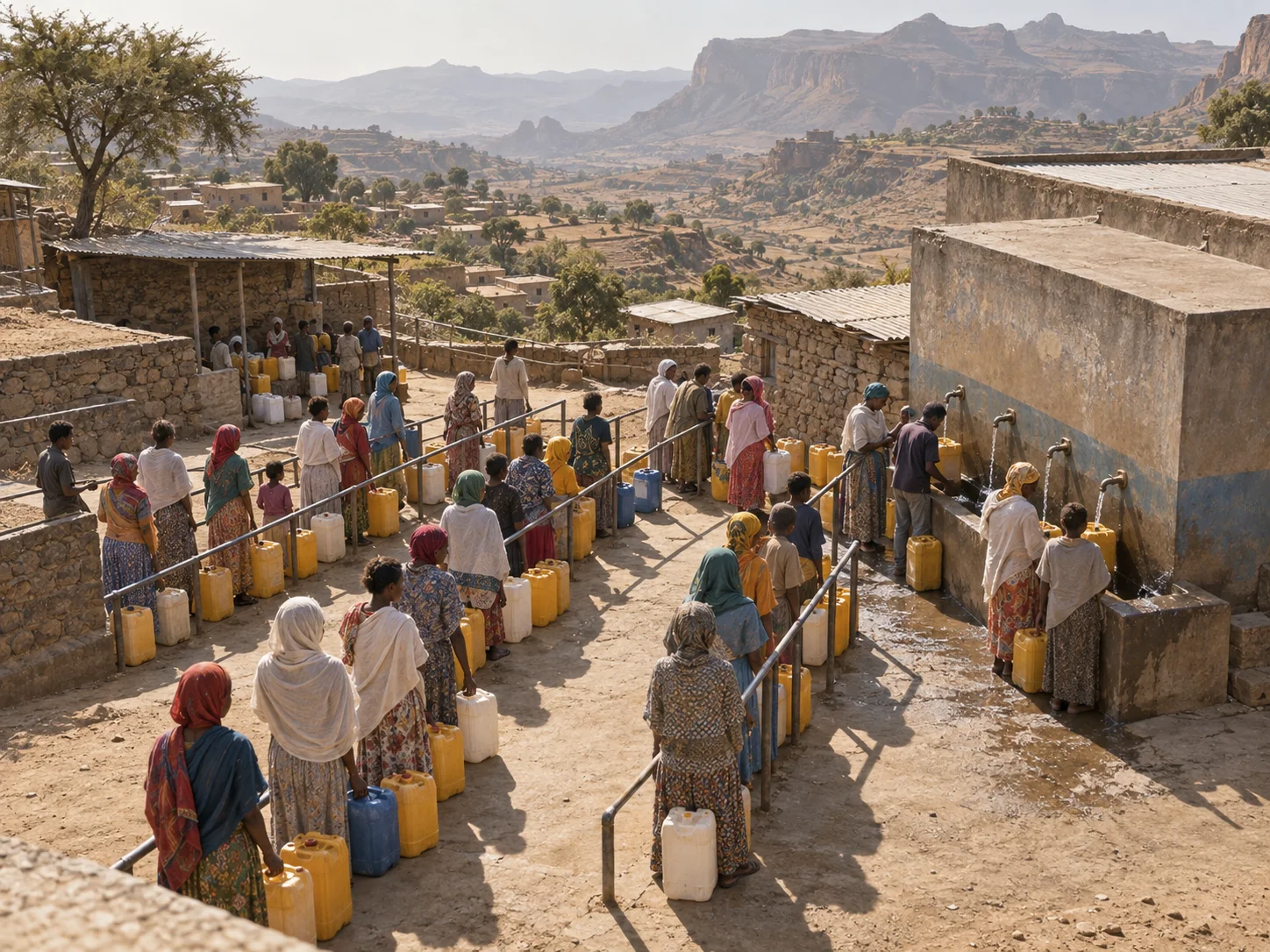
In Endamekoni district in Ethiopia's Tigray region, Hadas Hailemariam once spent as long as six hours walking to fetch water for her family. UNICEF's 2024 account says that arrival did not end the ordeal: long queues formed at the source, and her 25-litre jerrycan was sometimes not filled at all. Another resident, Aziya Haile, reported waiting up to four hours for water. The queue therefore began only after the journey itself had already consumed a large part of the day.
Drought and conflict had compounded the weakness of local water infrastructure. A solar-powered system supported by UNICEF and its partners now pumps groundwater to roughly 600 households, more than 3,000 people. Hadas said the new collection point was about a fifteen-minute walk from her home.
The distinctive fact is not merely that people travelled far for water. Even after a journey of up to six hours, there was no guarantee that the container would be filled. The new system reduced more than distance: it reduced the uncertainty around which an entire day had to be organised, including the possibility of walking home with an empty jerrycan.