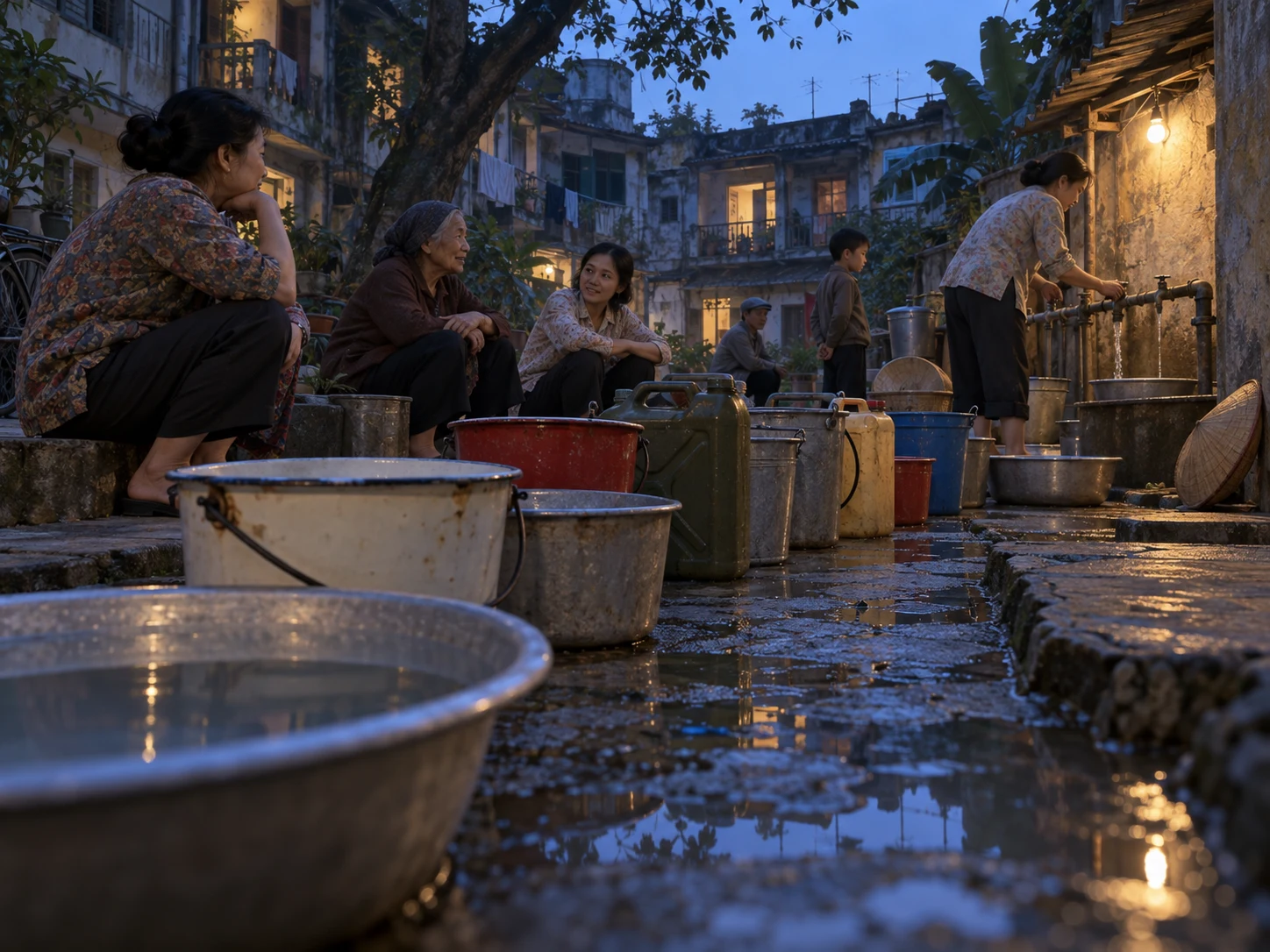
In Hanoi during the 1980s and early 1990s, weak pressure kept water from reaching many homes. Residents of apartment blocks watched for supply at night, dug pavement storage tanks and queued at communal collection points. A Tuổi Trẻ history identifies the turning point as Finland’s US$80 million grant programme from 1986 to 1997. Water plants were upgraded or built, roughly 410 kilometres of distribution network were added, household meters introduced and clean water extended to 1.9 million residents. Yên Phụ plant capacity rose from about 15,000 cubic metres a day to 80,000 by 1997. People still call a road following the pipes “Finnish Water Road,” although the name began informally. The queue that disappeared became a household-scale measure of infrastructure: reliable pressure meant no longer arranging the night around a public tap.
Vietnam · 1980–1990 (period details in article)
Hanoi’s Night-Time Queue for Water Pressure