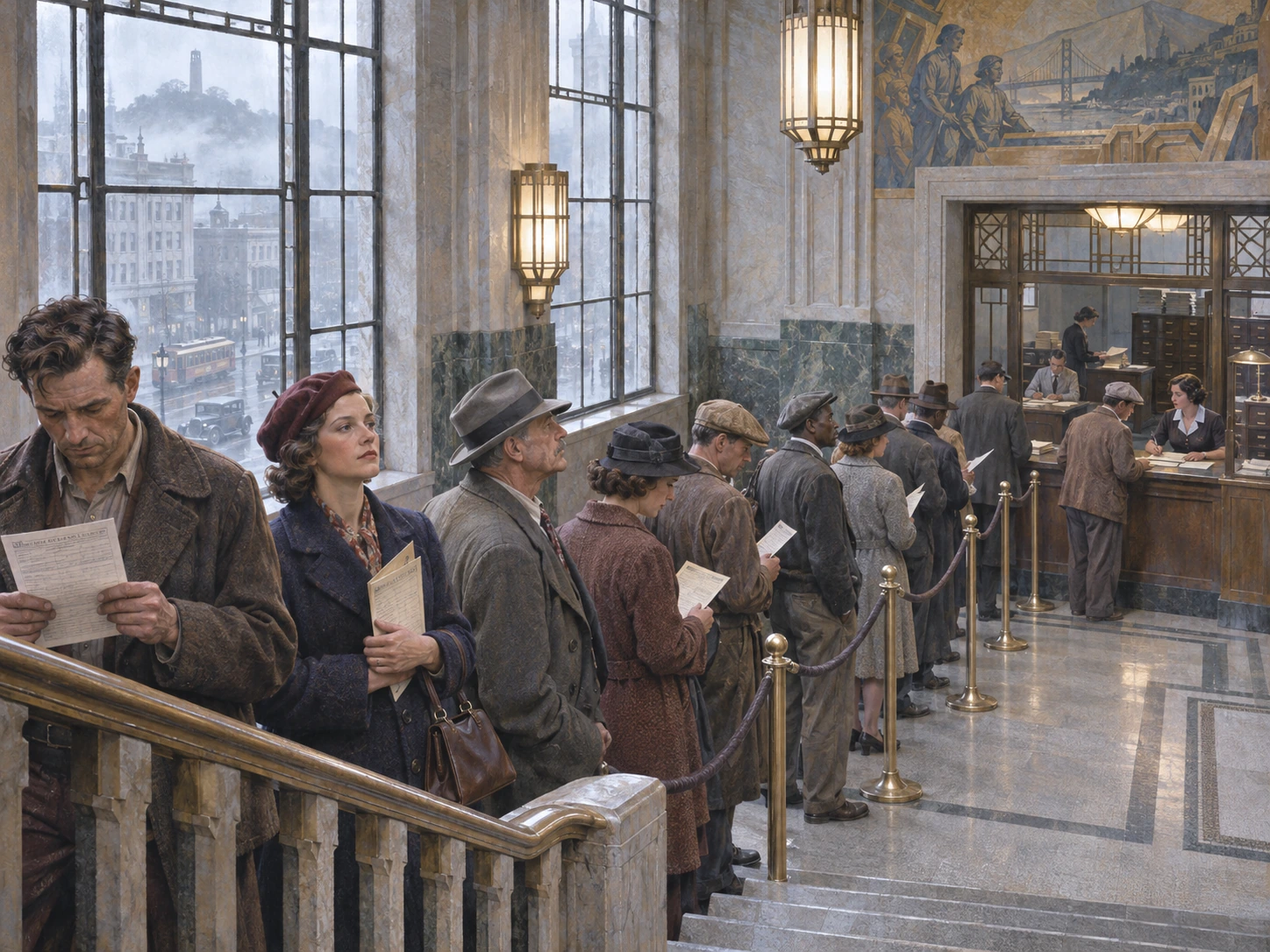
In 1938, men formed a line inside a California State Employment Service office in San Francisco to register for unemployment benefits. The Library of Congress catalogue identifies the scene as one of the first days the office was open for the programme. It also records the benefit terms: six to fifteen dollars a week, payable for as long as sixteen weeks. The caption places the opening beside a federal unemployment census reporting close to ten million people out of work and notes that twenty-two states were beginning unemployment-compensation payments. What the men awaited was therefore not an established charity distribution but entry into a newly operating public-insurance system. The photograph shows policy at the moment it became clerical procedure: applicants arriving, taking places and waiting to be registered. The record does not tell us each man’s occupation, household circumstances or eventual eligibility, so the image cannot support invented personal stories. Its documentary force comes from the contrast already present in the catalogue. “Close to ten million” describes unemployment at national scale; six to fifteen dollars describes the weekly benefit; the line inside one office connects the two. A social programme announced by government did not reach anyone automatically. It became real through individual registrations processed in sequence. The stated terms clarify what registration could unlock. Applicants were not waiting for a single handout but for entry to weekly payments that, if eligibility was established, could continue for up to sixteen weeks. The line was the first administrative link between a new insurance principle and a household budget.
United States · 1938
Registering for America’s New Unemployment Benefit