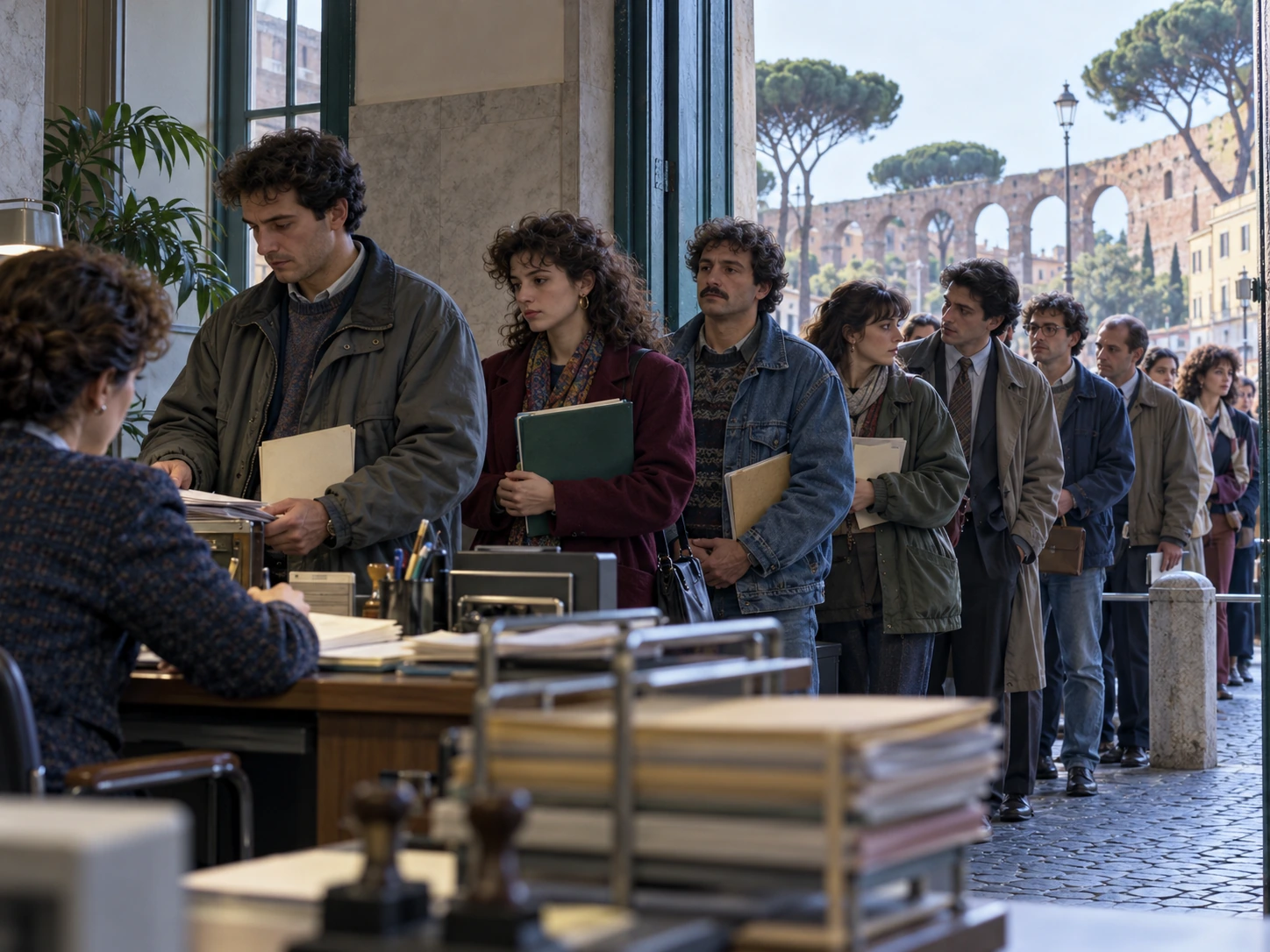
On 11 April 1991, the Italian newspaper l’Unità reported on Rome’s public employment office under the headline “In fila al collocamento”—in line at the employment office. The article described job seekers visiting the Via Appia office and checking the progress of their cases; its accompanying caption recorded people waiting inside the office. During 1990, about 99,000 people presented themselves there to join the waiting register, and the year-end total reached 200,918 registrants.
Two kinds of waiting met in this case. One was institutional: years spent on an employment register. The other was physical: taking a place at the office to enter or navigate that system. A CGIL study discussed in the report also found that many newly hired respondents had obtained work through personal connections rather than the public placement service. The queue therefore exposed not only demand for jobs, but the limits of the machinery meant to distribute opportunity. In Rome, the hope of employment became both a name on a list and a body waiting its turn.