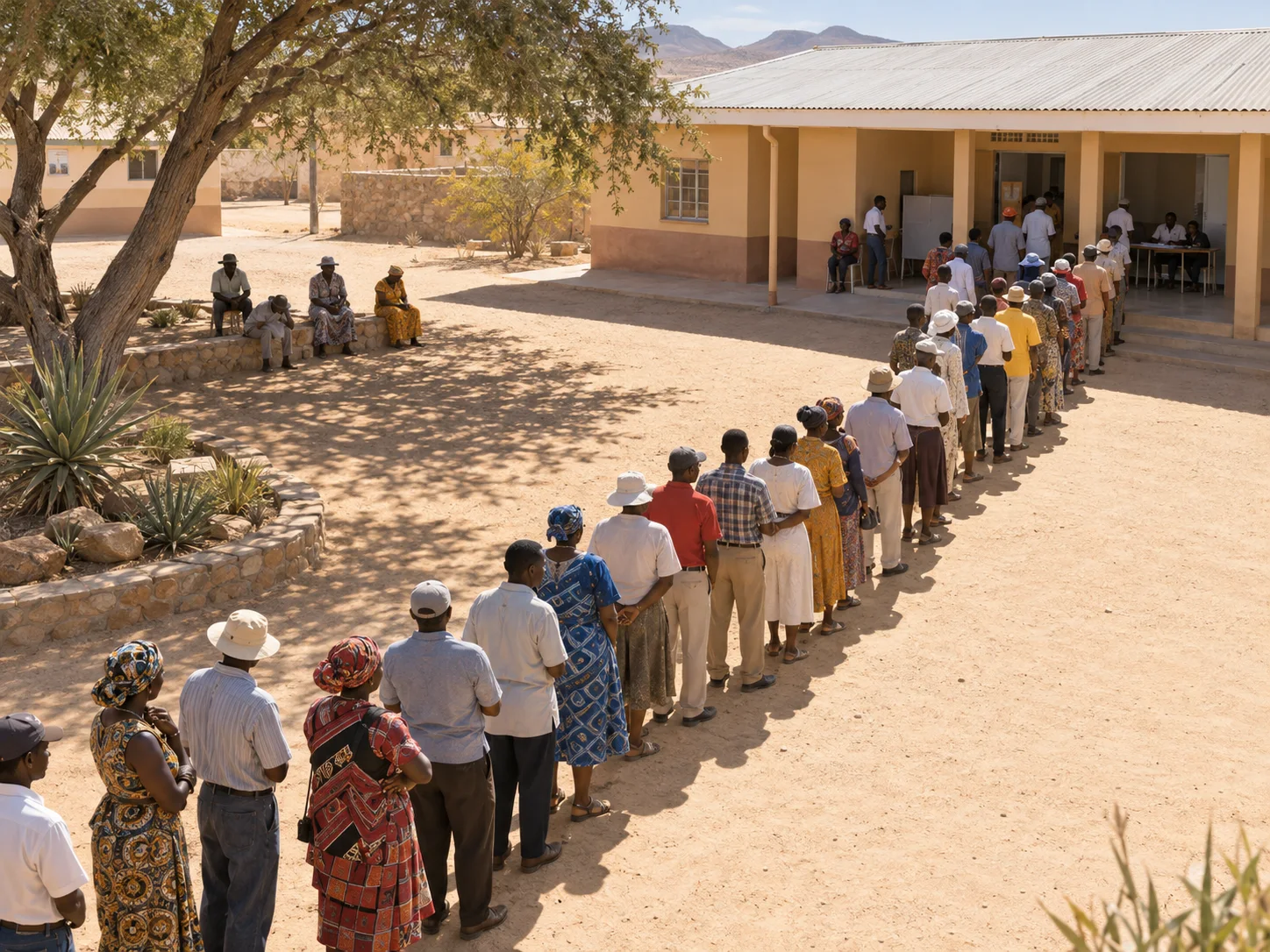
In November 1989, voters queued outside a polling station at Ondangwa, in northern Namibia. The Australian War Memorial preserves a photograph of the scene. People had dressed in their best clothes; some carried umbrellas against the sun. The museum’s description gives the temperature as 45 degrees Celsius. A United Nations armoured vehicle appears nearby. In one frame, the familiar act of waiting to vote shares space with the machinery of an international peacekeeping mission.
This was not an election held after independence. It was the election for a constituent assembly that would help take Namibia from South African rule towards independence. The United Nations Transition Assistance Group, known as UNTAG, supervised the transition, and Australian troops helped provide security. According to the War Memorial, the polling station pictured stood about 300 metres north of the Australian base. A ready-reaction force travelled between polling sites in protected vehicles, prepared to respond to trouble.
An account published by the Australian government's Anzac Portal records the memories of an electoral specialist involved in the mission. He recalled enormous lines, including some said to stretch for two kilometres, and stories of people beginning to wait the night before so they could be first to vote in their villages. Those recollections describe the election more broadly; they do not establish the length of the particular line photographed at Ondangwa.
The picture cannot tell us whom any voter supported or what they privately hoped for. It does show people making an occasion of voting, preparing for the heat and giving up part of their day to take their turn. On a historical timeline, independence can look like a single arrow between two dates. At the polling station it unfolded one person at a time, under an unforgiving sun.
In heat approaching forty-five degrees, voters who dressed carefully treated the ballot as a public occasion rather than a routine errand. Their clothes did not reduce the burden of waiting; they showed what the day meant.