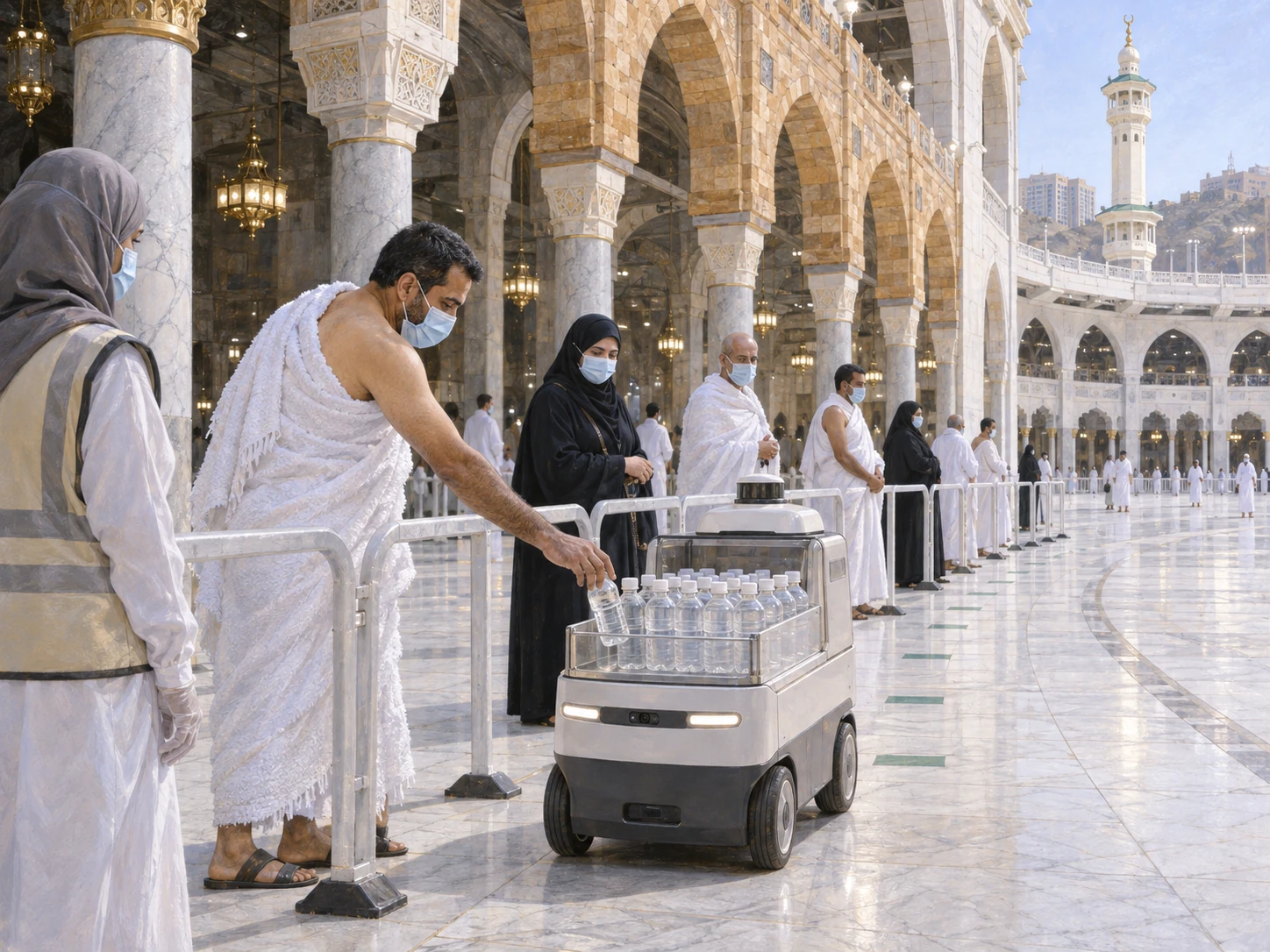
In June 2021, pilgrims at the Grand Mosque in Makkah, Saudi Arabia, queued to receive sacred Zamzam water. Contemporary reporting explained that a newly introduced mobile robot would remove the need for pilgrims to stand in line to quench their thirst. Carrying sealed bottles as it moved through the mosque, the machine allowed pilgrims and staff to take water one bottle at a time as it passed.
The system was introduced during the COVID-19 pandemic to reduce shared contact and the concentration of people at one distribution point. The 2021 Hajj was limited to 60,000 Saudi citizens and residents, yet the mosque still needed an orderly and hygienic way to provide water within a setting shaped by prayer and movement.
What distinguishes this queue is that the response did not merely process waiting people faster; it made the distribution point itself mobile. The religiously significant act of receiving Zamzam water remained, while pilgrims no longer had to converge on a single tap or counter. The candidate has been fixed to the place and date directly documented by the report, preserving both the physical queue and the technology introduced to dissolve it.