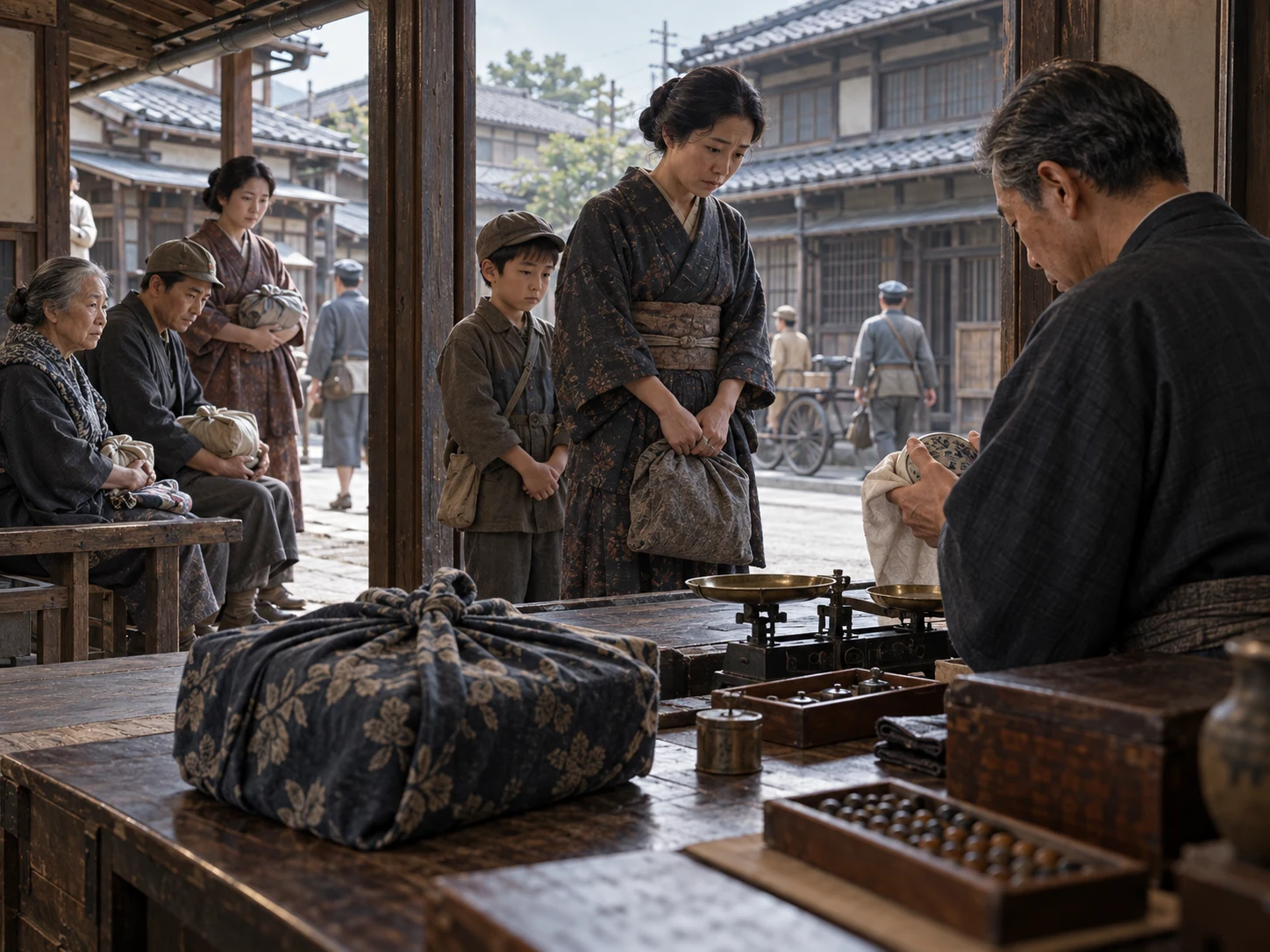
A propaganda leaflet dated 9 April 1943, now held by the Australian War Memorial, portrayed the economic effects of war on Japanese civilians. One of its two sketches shows a man with an empty cash box saying that he has no choice but to visit a pawnshop. The other depicts a long queue outside a city-run pawnshop.
This is not a documentary photograph. It was produced by the Allied Far Eastern Liaison Office for distribution in Japan and Formosa, so it cannot establish the identity of a particular shop or the number of people in line. What it does document is the choice of a pawnshop queue as an instantly legible symbol of wartime household distress. Even the difficult act of surrendering possessions for cash came with another ordinary requirement: waiting to reach the counter.