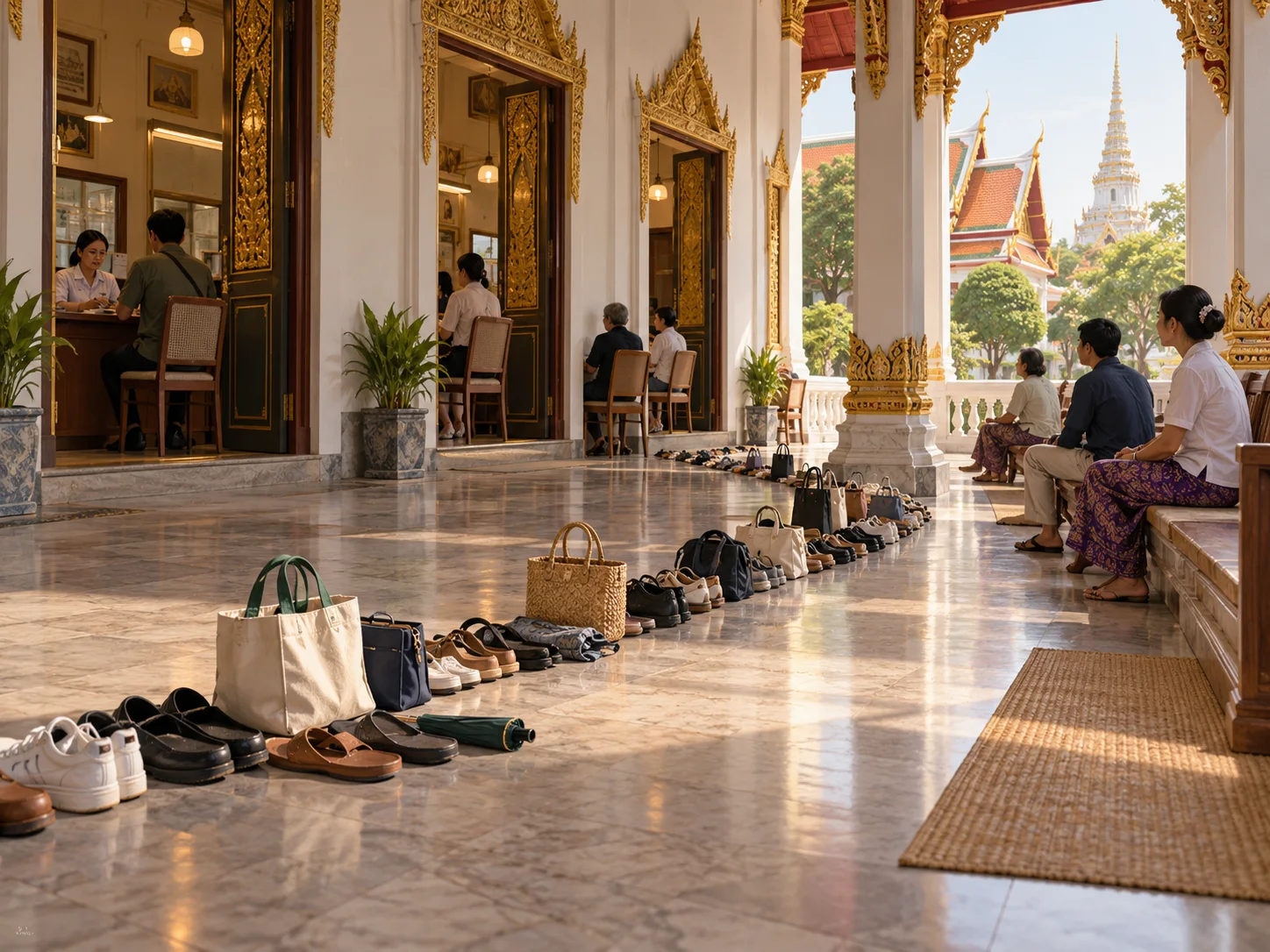
Photographs reproduced in a Bangkok government service-improvement presentation show sandals and shoes stretching along a corridor while their owners sit against the wall. The objects, not the bodies, curve toward a public-service counter. Each pair acts as a place marker.
The arrangement removes the need to stand in heat and reduces crowding near a narrow desk. In Thailand, removing footwear before entering temples and many homes is widely understood, which makes shoes readily legible as extensions of their owners. The system is not official, however. It depends on others leaving the markers untouched and on each person returning when called.
Its significance lies in separating the purpose of a queue from its familiar shape. The essential function is agreement about arrival order, not a line of upright bodies. While footwear preserves sequence, people can rest. The queue remains socially binding even after it has released the bodies that created it.
A numbered ticket makes the institution responsible for order. In a shoe queue every participant becomes a guarantor, saving equipment while leaving authority unclear if agreement breaks down.