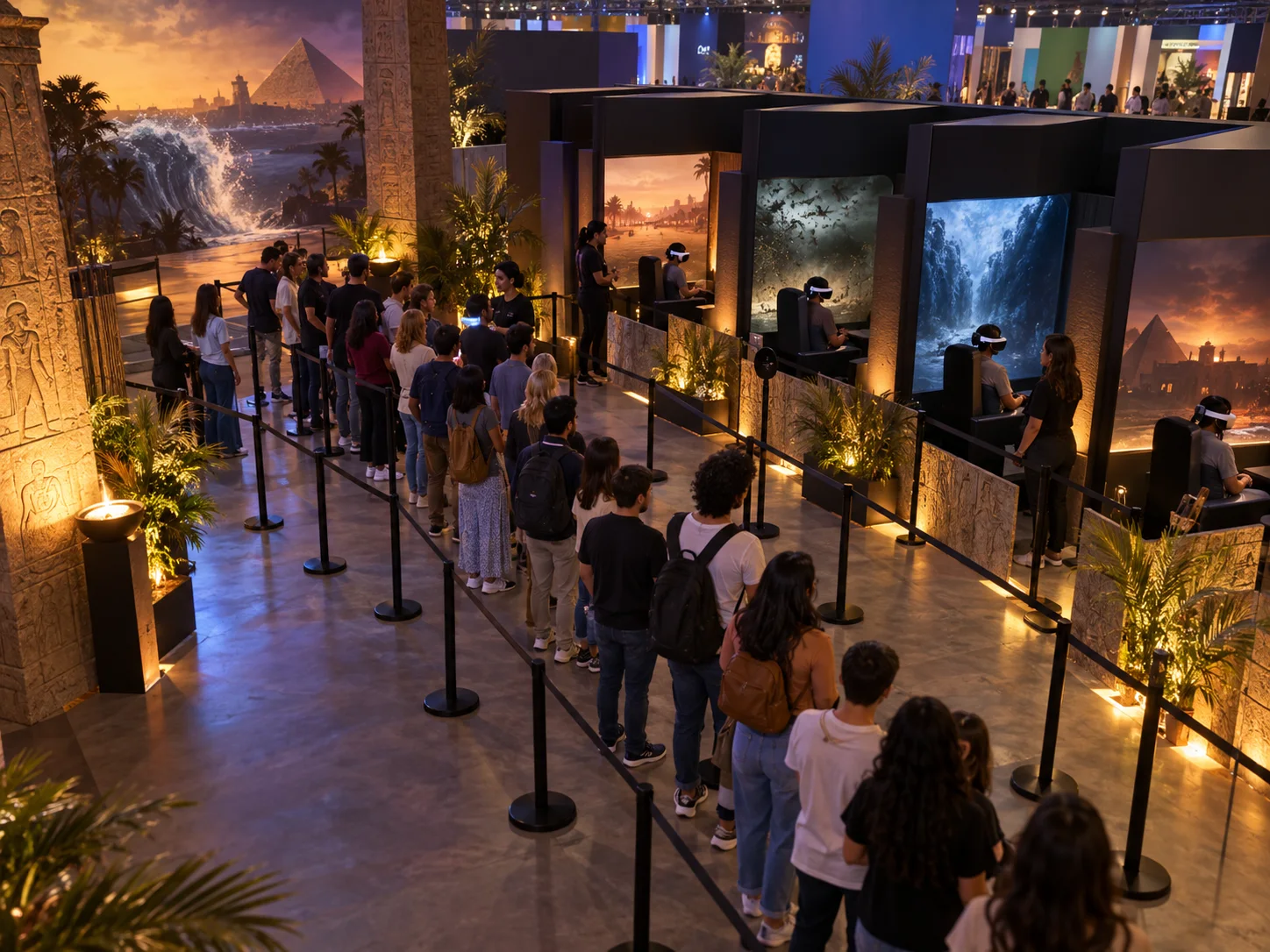
At Expo Cristã, Brazil’s Christian-industry fair, visitors queued in 2024 for an immersive attraction based on the Ten Plagues of Egypt. A report by Folha de S.Paulo followed a twenty-nine-year-old visitor who bought two shirts and then headed for the line. The experience retold the biblical plagues through performers playing Moses and Pharaoh Ramses. One actor said he had also portrayed Peter and Abraham, and that fees for such performances could approach 500 reais.
The fair assembled books, clothing, education, music and digital experiences aimed at Brazil’s large evangelical market. This queue was therefore not for a ritual inside a church. It was for a staged encounter with scripture offered in the format of a trade-fair attraction. Visitors moved from choosing merchandise to waiting for admission into a constructed biblical world.
What distinguishes the line is the junction it created between an ancient narrative and a contemporary exhibition business. Faith, teaching, theatre and commerce occupied the same floor, and the queue controlled entry to the point where those activities converged. The direct evidence for the line is brief—a reported scene involving one visitor—so the record does not invent attendance figures or a waiting time that the source does not provide. Its value lies instead in the precisely observed transition: after buying apparel, a fairgoer joined a line to experience a sacred story as performed media.
Quality check: Folha de S.Paulo’s on-site report dated 6 September 2024 directly records visitors queuing for the VR experience at the São Paulo Christian fair, with the attraction and fee context.