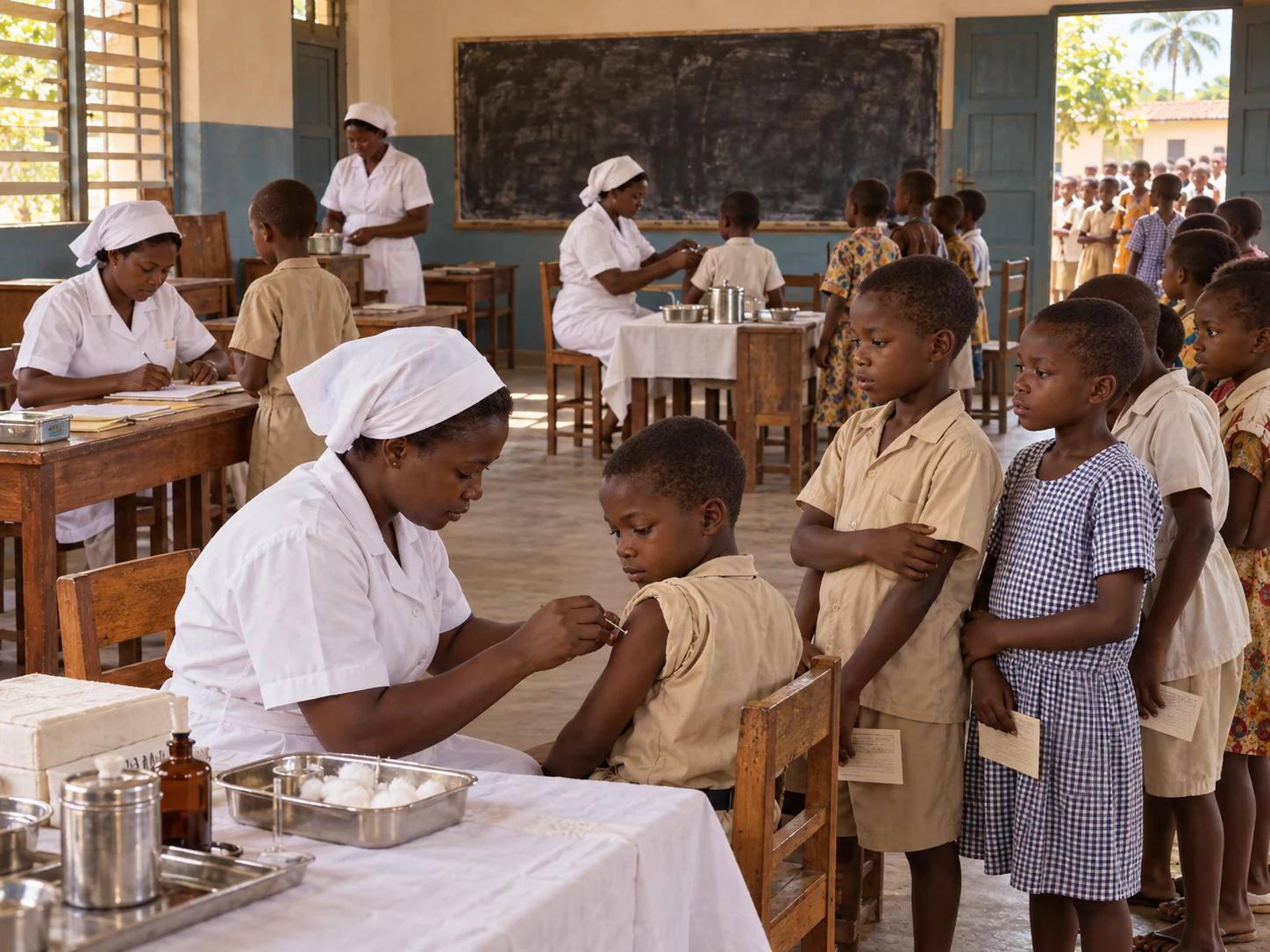
In 1968, local children formed a long line in Cotonou, Benin, to receive smallpox inoculations. The US Centers for Disease Control and Prevention preserves the scene as Public Health Image Library record 7076. Its caption identifies the country by its former name, Dahomey, and places the photograph within the worldwide smallpox eradication campaign of the late 1960s and early 1970s. The service at the head of the line was not a document or a ration but a medical procedure performed one child at a time.
Smallpox vaccination was already known, yet eradication required much more than announcing that vaccine existed. Teams had to reach communities, assemble recipients, record coverage and investigate new cases. A global programme became local only when individual people arrived at an identifiable place and moved through a repeatable sequence.
The CDC caption does not provide a headcount, a waiting time or the name of a school, so none is supplied here. Nor does the photograph establish what the children felt. What it does document is the operational form of prevention: a line of young residents waiting to place their bodies into a public-health campaign.
In 1980, the World Health Organization declared smallpox eradicated and recommended that routine vaccination cease. The Cotonou line therefore belongs to a rare kind of queue whose success eventually removed the need for the queue itself. The children waited before that outcome was certain. The image preserves the intermediate stage, when a disease was moving toward disappearance but protection still had to be delivered person by person. Because the image remains in a public archive, the campaign can be examined not only through final statistics but through the working unit of delivery: one child advancing to the vaccination point.