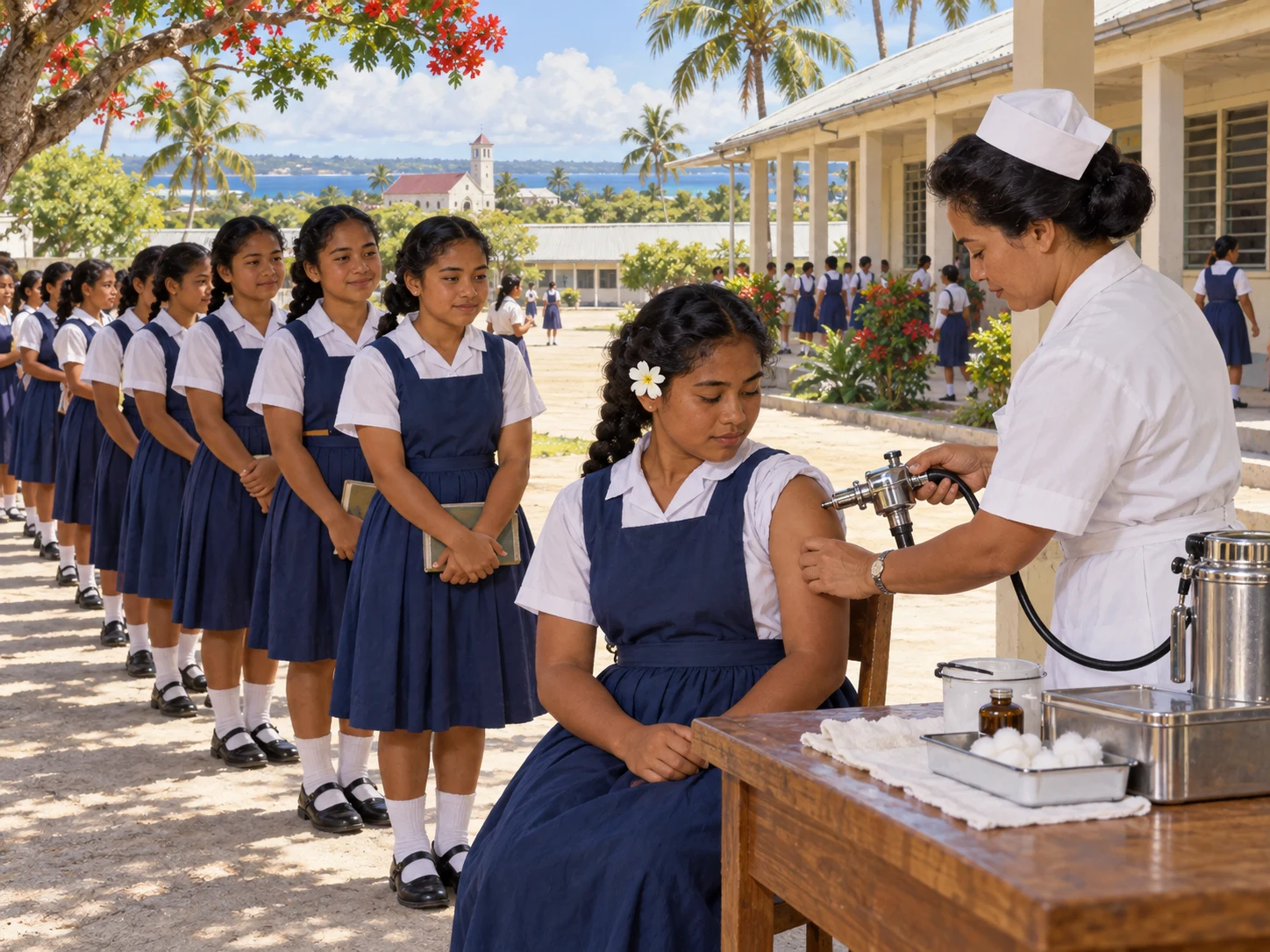
In 1964, students at Queen Salote College in Tonga stood in line for smallpox vaccination. CDC Public Health Image Library record 22247 identifies the setting as the grounds of the private all-girls school. A nurse dressed in white holds a multidose Ped-O-Jet pneumatic injector while the students await their turn.
The device matters because it changed the speed and organization of mass vaccination. Instead of preparing a conventional syringe for every recipient, a jet injector delivered vaccine through a high-pressure stream. It was designed for repeated use in campaigns that had to process many people. The queue was therefore not merely a crowd caused by delay; it was the human sequence that allowed one piece of equipment and one operator to work repeatedly.
The archive does not state how many students were present, how long they waited or whether participation was compulsory. It would also be wrong to treat one school as a complete account of vaccination across Tonga. The documented facts are narrower and stronger: female students at a named college waited in line while a nurse administered smallpox vaccine with a particular device.
Vaccination history is often told through discoveries, doses and disease statistics. This photograph adds another layer: delivery technology and orderly movement. The Ped-O-Jet did not abolish waiting. It made the line processable at a steady rhythm. The machine occupies the visual centre of the scene, but its public-health value depended on the students approaching it one after another. A school also supplied an existing roster and a controlled space. Those ordinary educational structures helped turn a population of students into an identifiable vaccination sequence.