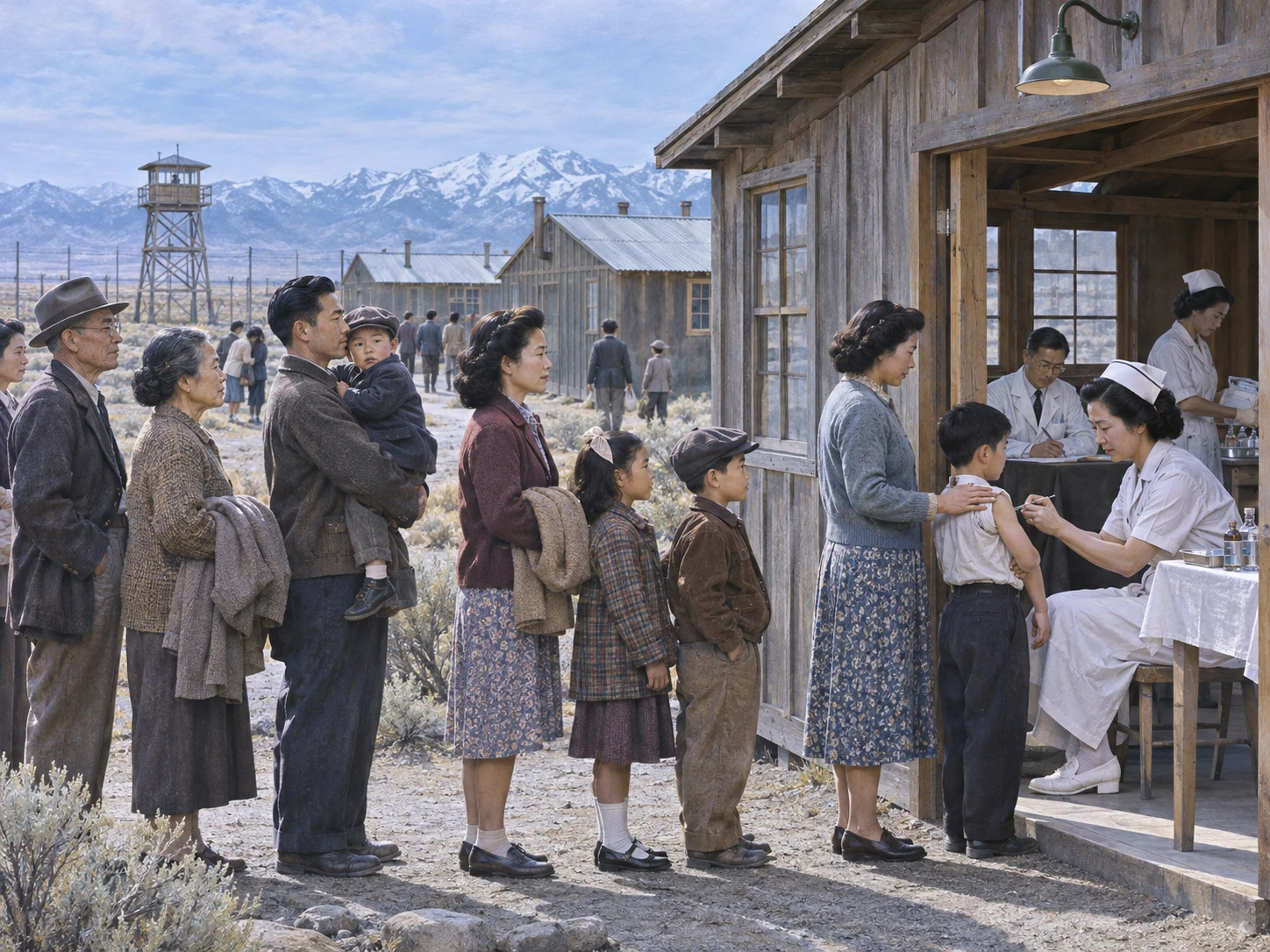
In 1942, Japanese American artist Miné Okubo stood in a long line for typhoid and smallpox vaccinations at the Tanforan Assembly Center in San Bruno, California. Her ink drawing records Okubo within the queue, people checking in at tables, and barracks and utility poles behind them. The Japanese American National Museum identifies the scene as occurring during the first month at Tanforan. The work later became one of 198 drawings included in Citizen 13660, Okubo’s graphic memoir of the two years she was incarcerated at Tanforan and Topaz. That context prevents the vaccination line from being treated as an ordinary public-health queue. The people waiting had been removed from their homes under U.S. wartime policy and confined in a temporary detention site converted from a racetrack. The drawing directly documents the line and its medical purpose; it does not authorize claims about every person’s private thoughts. Its distinctive evidence is instead the artist’s position inside the event. Okubo did not observe the administration of confinement from outside. She drew herself as one of the people processed through it. A national policy that assigned her the number in Citizen 13660 appeared in daily life as tables, barracks and a place in line for compulsory camp routines, including vaccination. Tanforan functioned as an “assembly center” before transfers to longer-term camps. The museum catalogues the work as ink on paper, created in 1942–44 and later given by the Okubo estate. Unlike an administrative photograph, this record was made by an incarcerated participant who deliberately placed her own figure within the queue.
United States · 1942
Vaccination in Line at Tanforan Assembly Center