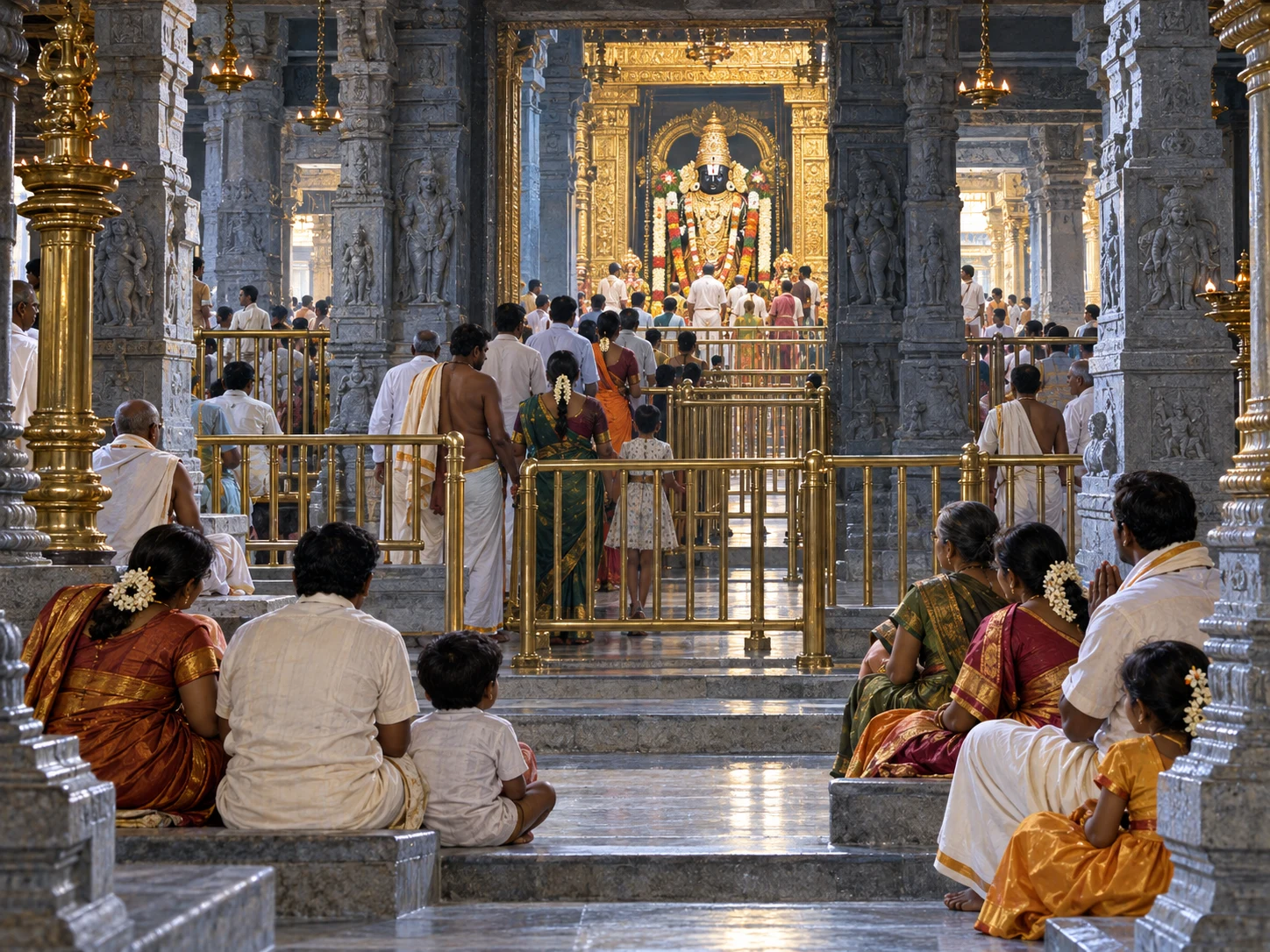
At Tirumala in southern India, pilgrims approaching the Venkateswara temple pass through a structure called the Vaikuntam Queue Complex. Rather than folding one line behind barriers, the complex divides visitors among halls and releases groups toward the sanctuary. When a temple receives tens of thousands of people a day, the place for waiting becomes part of its religious architecture.
The halls provide seating, drinking water, food, toilets and information. On crowded days the wait may last for hours, so this is not a single line that moves continuously. Pilgrims stop in one enclosure and advance when the next door opens. The arrangement preserves sequence while breaking crowd pressure into manageable sections.
The central moment of darshan—the sight of the deity—may be brief. Much of the visit is controlled waiting. That can seem paradoxical if speed is the only measure, but a vast number of people cannot safely approach one sacred point without storing time somewhere. At Tirumala, the queue does not merely occupy architecture; architecture has been built to hold the queue.
At the Vaikuntam Queue Complex, waiting was not pushed outside the temple grounds; it became one of the building's functions. The unusual feature is that even the time spent approaching the shrine was treated as something architecture could organise.