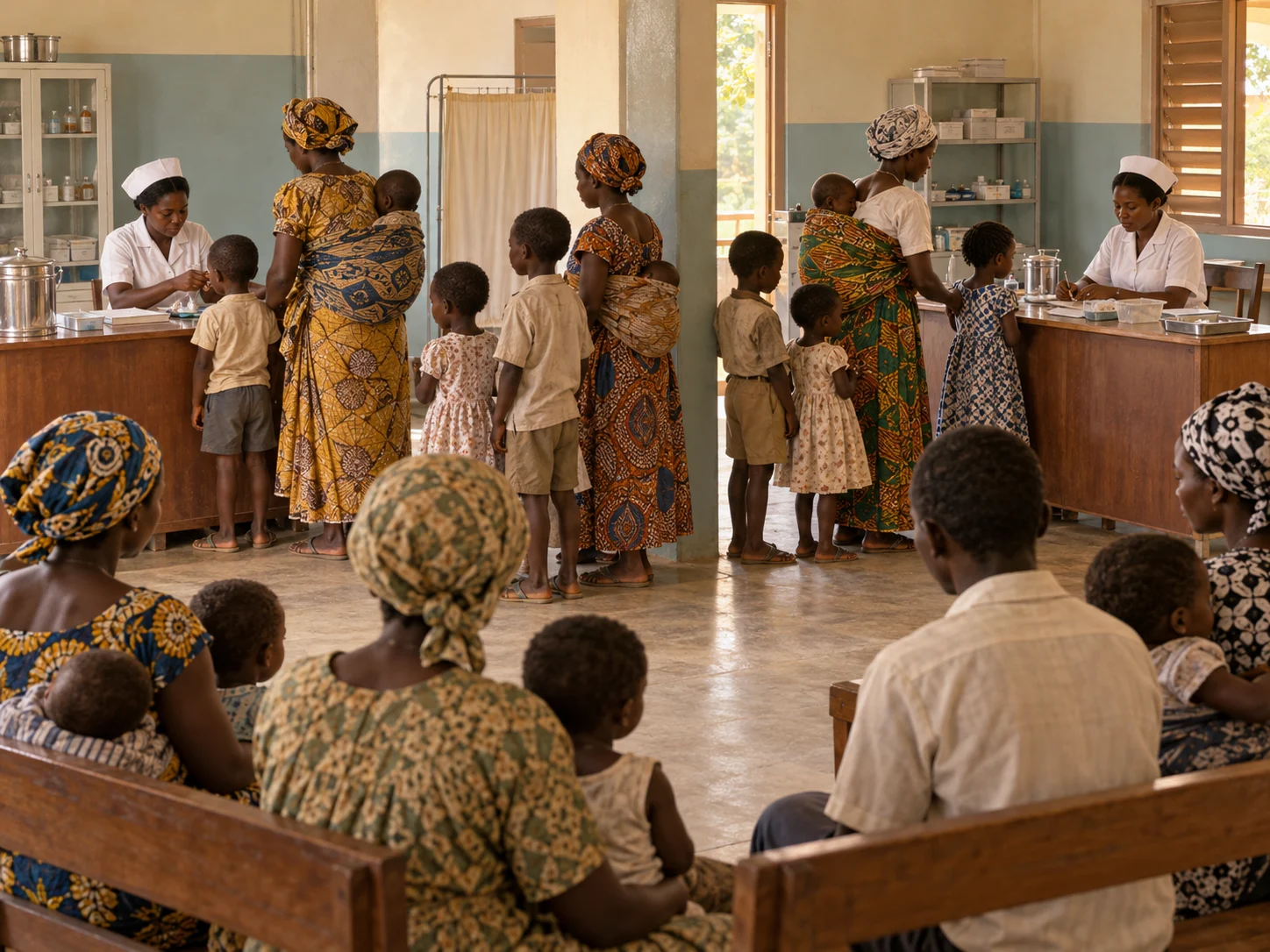
A WHO photograph from 1968 shows West African boys standing in a line, each awaiting vaccination against both smallpox and measles. The line did not merely organize a clinic. From 1966, governments in more than twenty newly independent countries in western and central Africa worked with WHO, USAID, and the US Centers for Disease Control on programmes that paired measles control with smallpox eradication.
The two vaccines did not present identical problems. Measles vaccine was heat-sensitive and depended on a functioning cold chain across long distances. Smallpox campaigns increasingly relied on freeze-dried vaccine and the bifurcated needle, a simple tool that made rapid mass vaccination possible. WHO’s photographic archive preserves other versions of this ordered wait: villagers lining up at an outdoor clinic in Côte d’Ivoire in the 1970s, and Mecca pilgrims waiting for vaccination tickets in Mogadishu in 1977.
What distinguishes the 1968 line is the way one child-sized sequence served two population-scale objectives. Each child was counted and vaccinated individually, but the outcome was measured in interrupted transmission across entire countries. By May 1967, The Gambia had become the first country to interrupt transmission of measles virus; Africa’s last naturally occurring smallpox case followed in 1977. The queue was both a period of waiting and a production line for public health, where two campaigns met at a single arm.