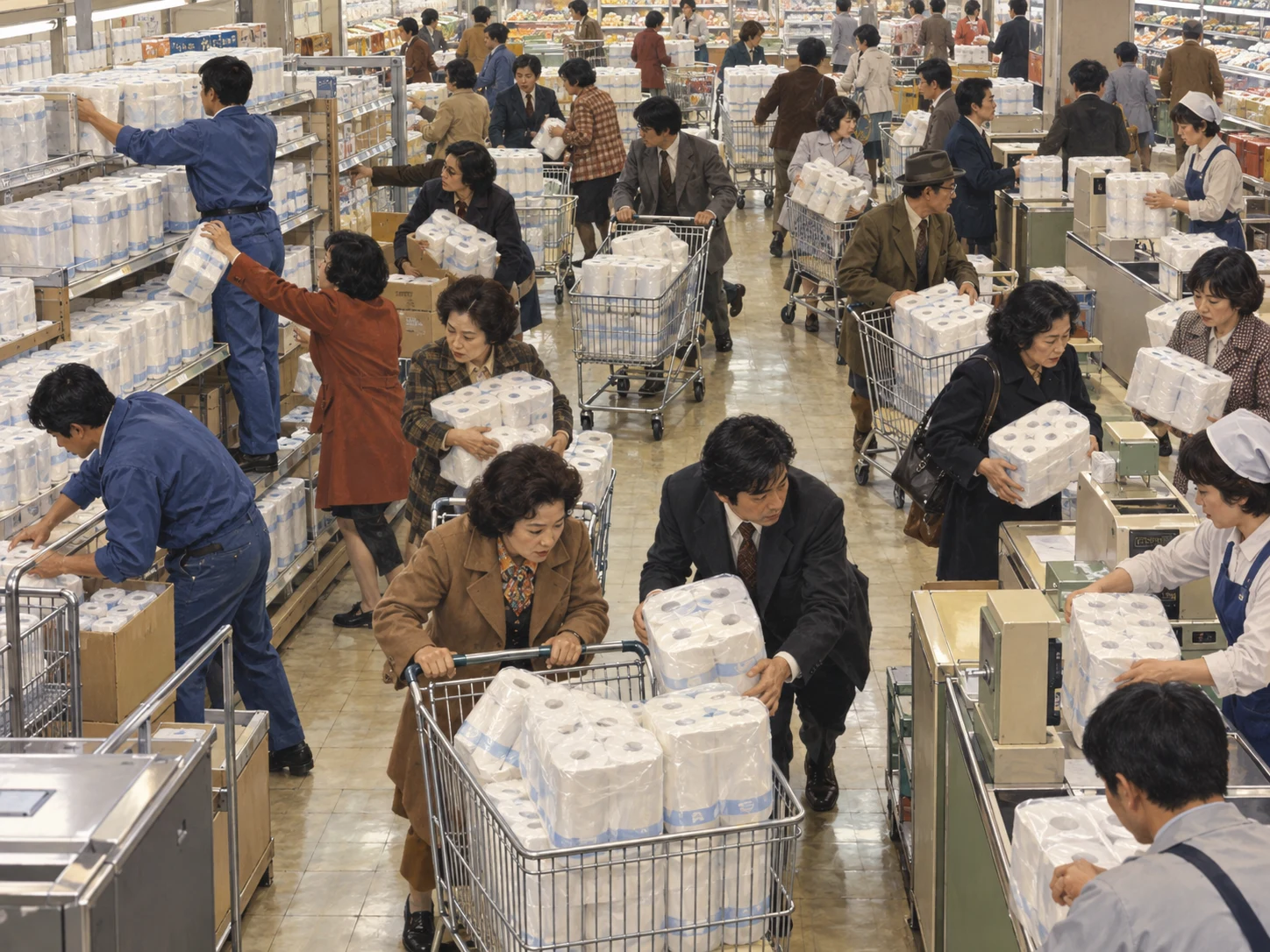
On 24 November 1973, shoppers were already waiting before a supermarket opened in Akabane, Tokyo. At times, about 100 people lined up for sugar, detergent and toilet paper. A Withnews article drawing on the Asahi Shimbun photo archive records the date and place and shows a security guard organizing the line.
The oil crisis did not cause a toilet-paper shortage simply because petroleum and paper were the same raw material. Anxiety about prices and supplies concentrated on familiar household goods. Stockpiling emptied shelves; the empty shelves then became evidence that encouraged more stockpiling. The queue was both a consequence of scarcity and a visible forecast of scarcity to come.
What makes this line distinctive is the speed of information rather than the speed of paper production. Buying early can be rational for one household, but when many households make the same decision at once, private preparation accelerates public shortage. A hundred people waiting for opening time showed an international economic shock arriving in the domestic cupboard.