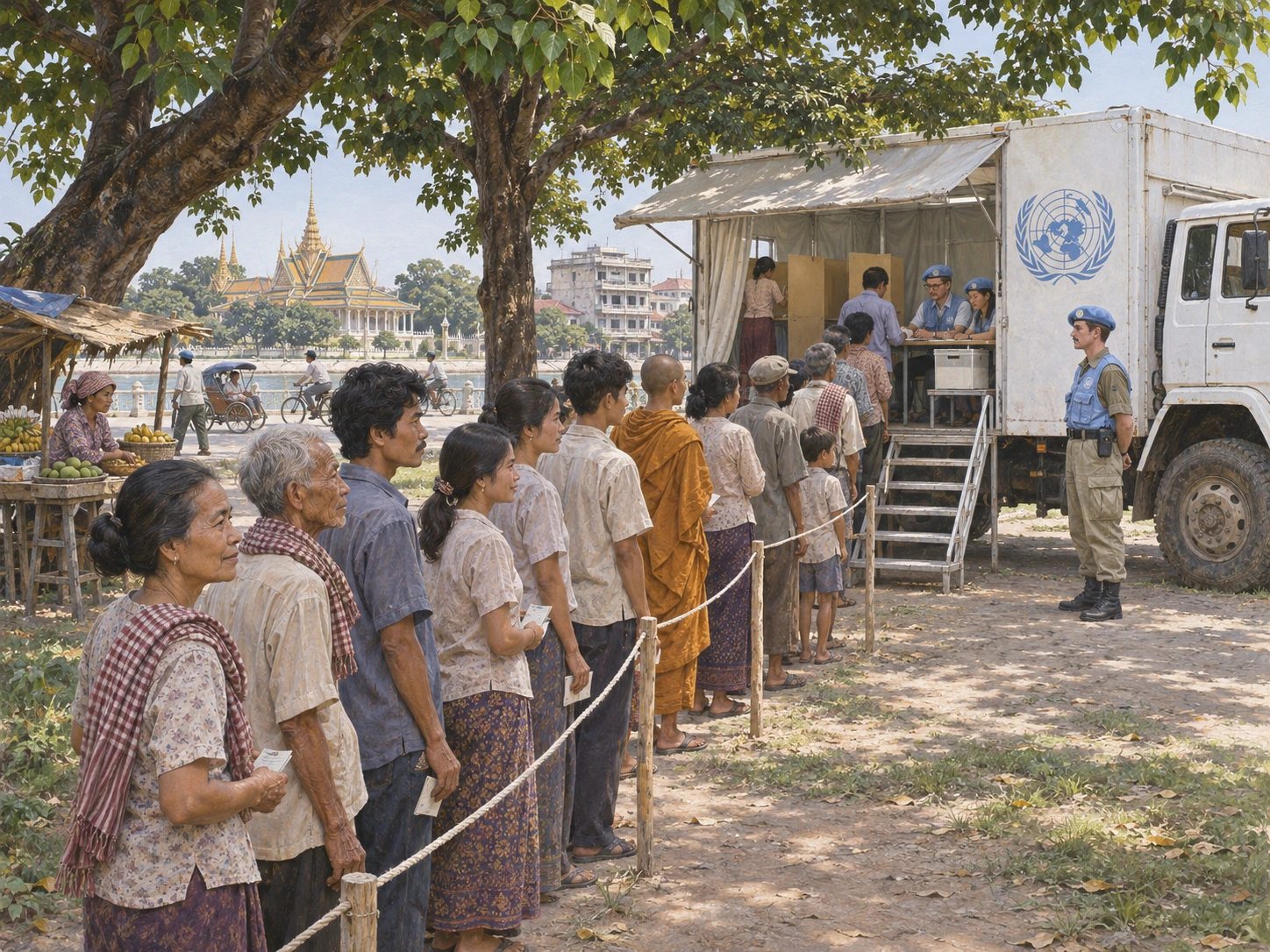
On 30 May 1993, civilians in a remote rural part of Cambodia waited in a line leading to a white United Nations truck. Its cargo area had become a mobile polling station, and voters climbed a ladder one at a time. At the entrance, a soldier serving with the United Nations Transitional Authority in Cambodia checked identification. In a country where war had damaged roads and public administration, the ballot box was not placed in a permanent building: the polling station itself had driven to the village.
About 4.27 million people—89.56 percent of registered voters—participated in the election organised by UNTAC. Mobile arrangements alongside fixed stations were a way to extend secret voting into remote areas. The queue did more than hold people in order: it moved each voter through identification, the ladder and the enclosed act of voting.
What makes this line distinctive is that it ends not at a school or government office but at a parked truck. The travelling polling station finally stops, and the voters begin to move. Where national institutions had struggled to reach, democratic order was assembled from one vehicle and one ladder.