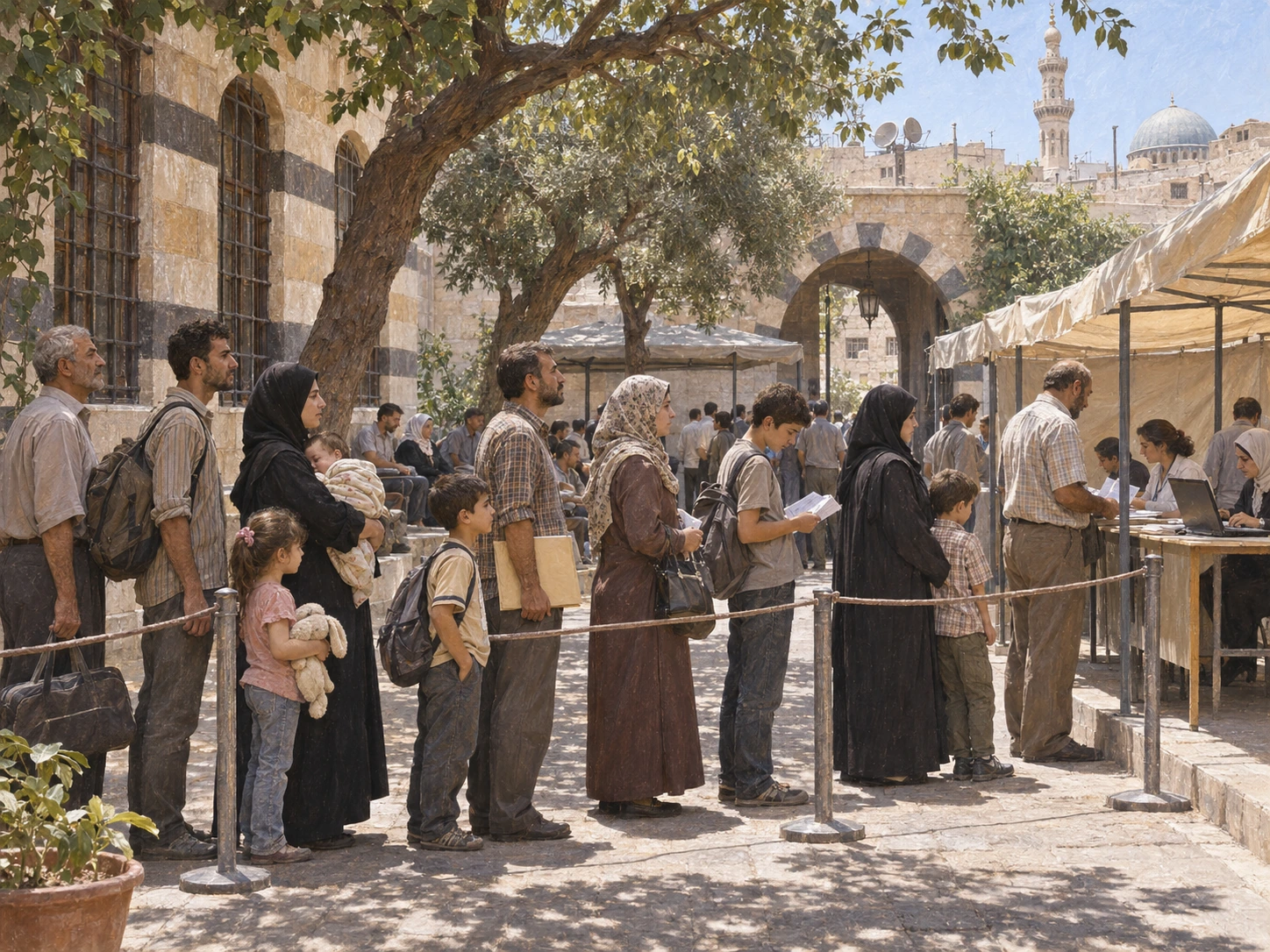
Registration could be a first opportunity to make a household visible to an organisation trying to understand displacement and needs. Names, family circumstances and ways to make contact mattered. But registering did not, by itself, promise a home, income or safety. The destination of the line was an administrative encounter, not the end of uncertainty.
The recorded line of roughly 5,000 Iraqis outside UNHCR in Damascus shows that flight does not end at the border. Registration opened routes to assistance and possible resettlement without promising the same outcome to every applicant.
Crossing a border can look like the end of a journey on a map. For Iraqis who fled to Syria, it could instead mark the beginning of another set of tasks. UNHCR, the United Nations refugee agency, reported people queueing outside its Damascus office to register. This is not a line imagined from the existence of a registration system: the agency described a particular place and a particular purpose.
There is a temptation to turn such scenes into stories about extraordinary patience. That would miss the ordinary demands that continued during the wait: caring for children, finding food and deciding where to sleep. A border appears on a map as a single stroke. Reaching a secure life may require crossing many less visible boundaries. Outside the office in Damascus, one of them had taken the form of a queue.
UNHCR's account identifies about 5,000 Iraqis outside its Damascus office. Registration was not the end of displacement; it was the point at which a person tried to become visible to an aid system.
UNHCR recorded about 5,000 Iraqis waiting outside its Damascus office for registration in February 2007. Registration did not itself guarantee safety, but it documented protection needs and opened routes to assistance or possible resettlement. Crossing a border had not ended the wait; another turn was required to become visible to the protection system.