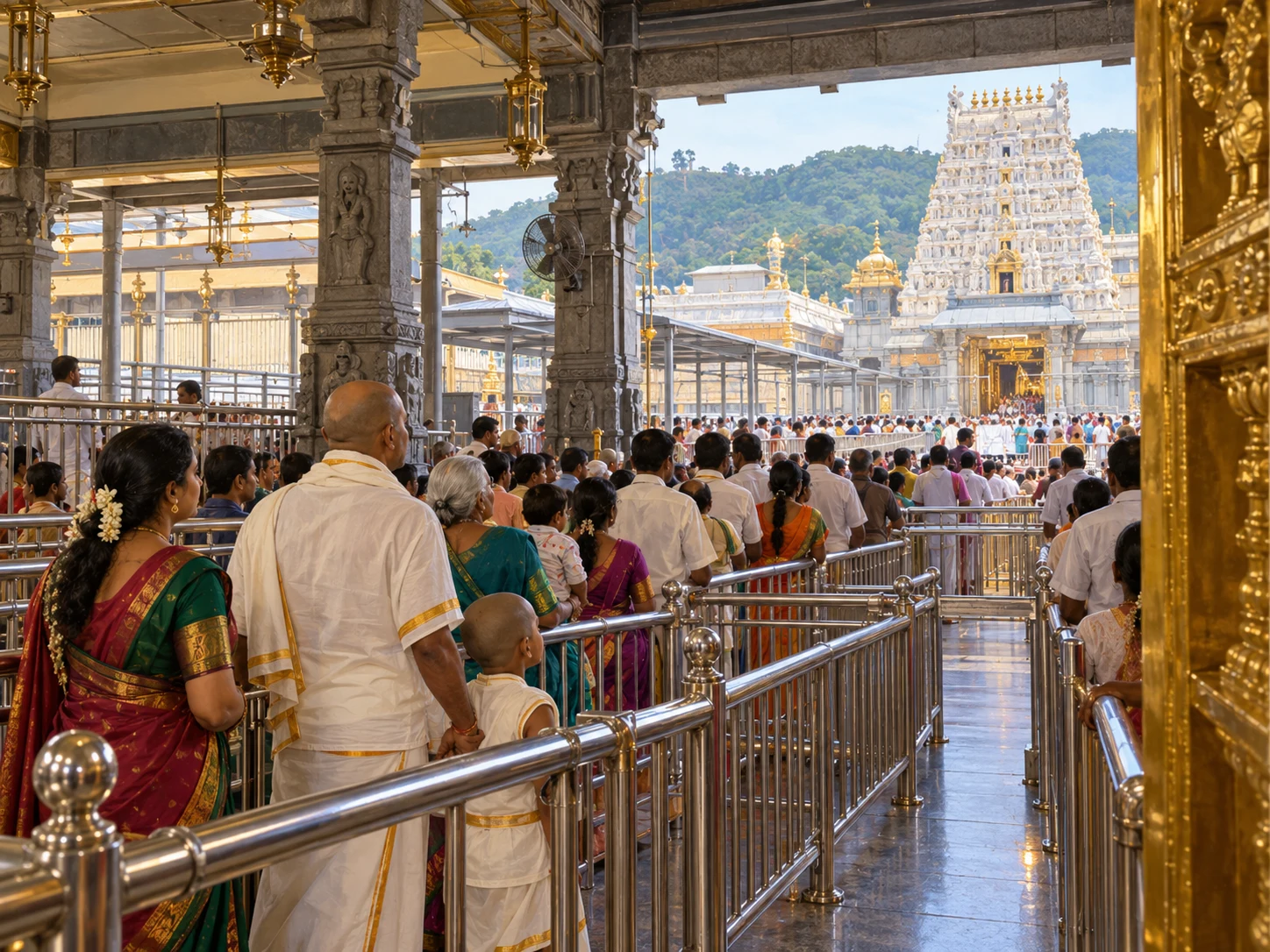
At Tirumala in southern India, the free route to the Venkateswara temple is called Sarva Darshan. Official temple guidance describes pilgrims waiting in compartments of the Vaikuntam Queue Complex and being released in sequence towards the deity. Admission may be free, but time is not. Waiting varies with attendance, and several managed spaces can stand between arrival and the brief encounter in the sanctuary.
Darshan is not simply looking at a building. It is a religious encounter in which the worshipper sees and is seen by the deity. To make that intensely personal act available to very large numbers, the temple divides the crowd into controlled groups. The queue is therefore not only a single line stretching through a corridor. It is also a series of rooms holding people until the next section can accept them.
An hour does not impose the same burden on an older visitor, a family with children and a pilgrim who has travelled a long distance. Devotion should not be used to pretend that waiting has no cost. The distinctive paradox is that access to a private moment of prayer requires highly organised collective delay. The glimpse itself is free; the time required to reach it is carefully allocated by compartments and turns.