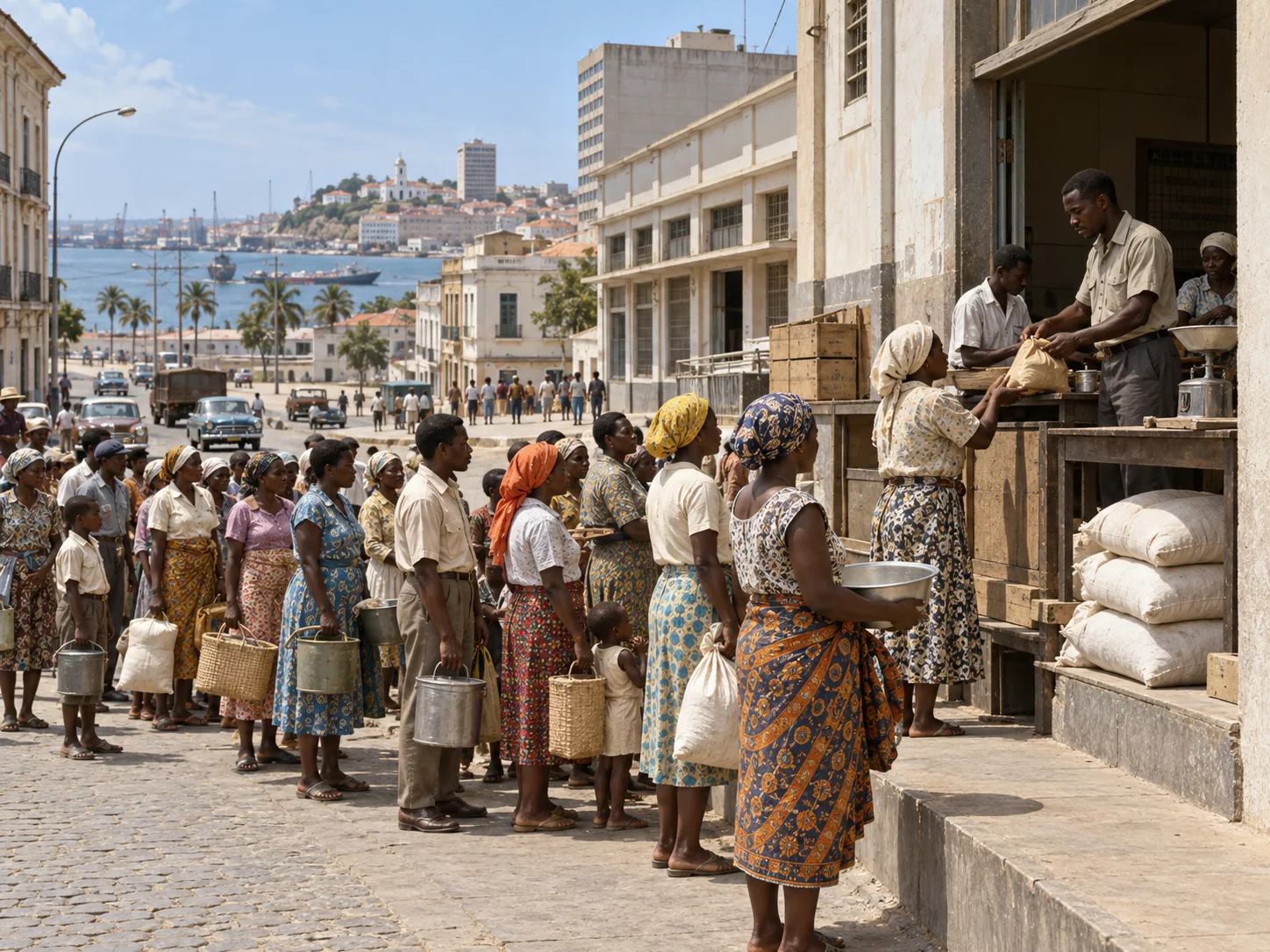
The audiovisual archive of the International Committee of the Red Cross preserves a 1982 photograph from a transit camp at Katchiungo in central Angola. Its catalogue describes the distribution of maize flour and shows recipients leaving with food. The record is indexed with women, children, camp and food aid. Although the candidate catalogue assigns the subject to the 1970s, the directly documented scene dates from 1982, and this article follows the evidence rather than forcing the metadata.
Angola entered civil war soon after independence in 1975. Displacement, damaged agriculture and disrupted transport made relief distribution part of daily survival. A queue at a transit camp was not an ordinary retail line. Displaced households received a staple through an organised sequence in which available stock, household units and the amount issued had to be reconciled.
The archive caption does not provide a headcount, waiting time or measured line, so none is invented here. What it establishes is more concrete than the general statement that aid existed: recipients assembled at one distribution point and moved away after maize flour had been issued.
The flour was not yet a meal. It still had to be carried, mixed with water and cooked with fuel. The order at the distribution point was therefore not the end of relief, but one stage in the work required to produce a family’s next food.
The ICRC photograph catalogue directly records a 1982 queue in Angola for the distribution of maize flour. The staple was not merely an individual ration: each place represented meals for the household to which the recipient would carry it.