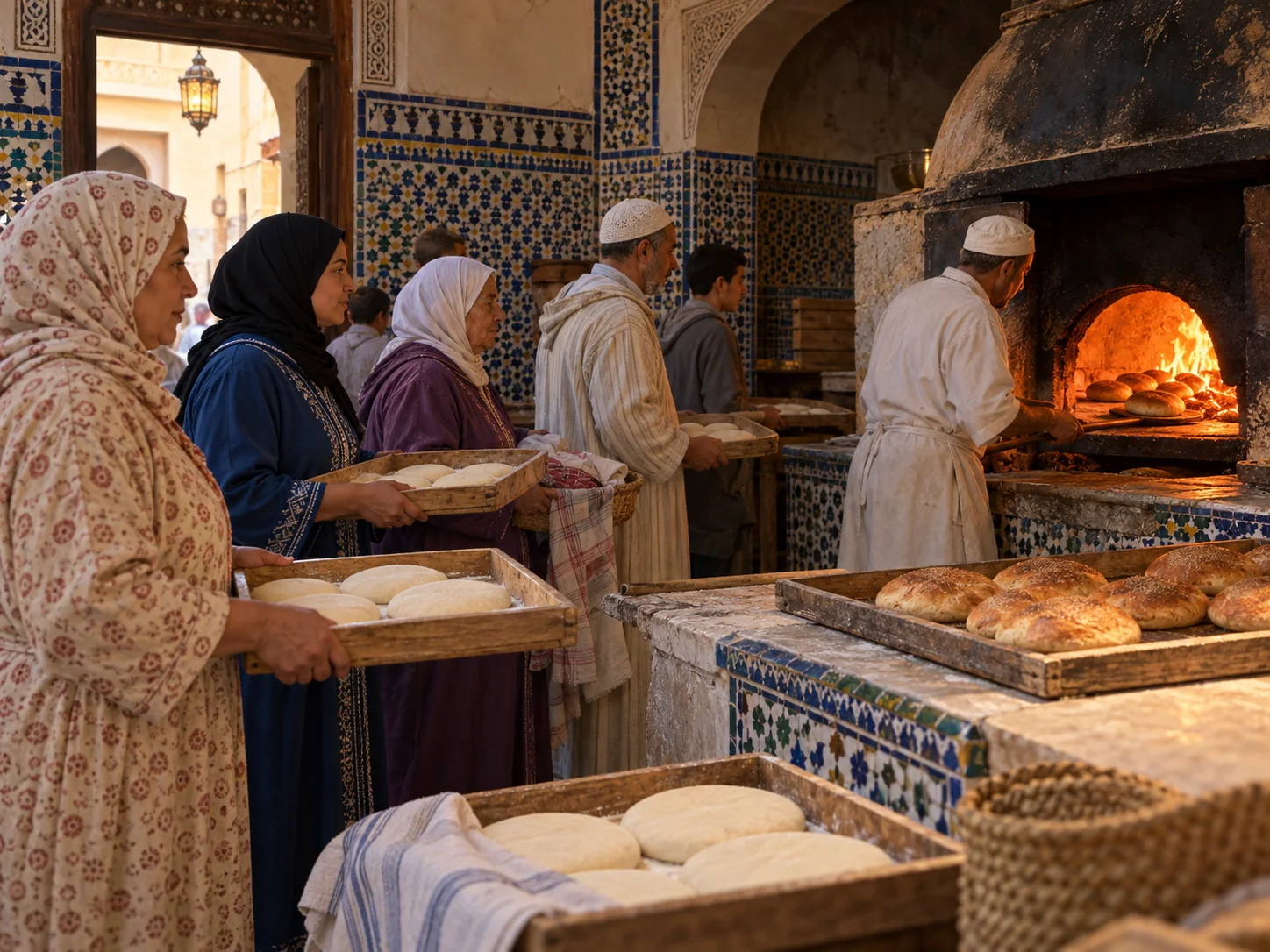
In the old medina of Fez, Morocco, families still carry bread shaped at home to a neighbourhood communal oven, or ferran, where a specialist bakes it. A reported account of Fez markets and cooking records people taking home-made bread and pastries to the communal oven and waiting while they bake. A separate account of Fez ovens explains how boards of household loaves arrive each morning and how the oven manages their order.
The “queue” here differs from a conventional line in which people remain standing. The baker receives boards and trays, then processes them in turn through limited oven space and heat. Household marks and shapes help identify similar-looking loaves so that each can be returned correctly. Under Method C, THE QUEUE ATLAS treats this as a RELATED EVENT: an ordered flow of bread and trays, not a claim that residents formed a continuous human line.
Dough and recipes remain domestic, while the fire is shared by the neighbourhood. Waiting is part of a system that distributes scarce oven capacity and returns a daily staple to the right home. Keeping it distinct from an ordinary queue reveals another way in which order supports everyday life.