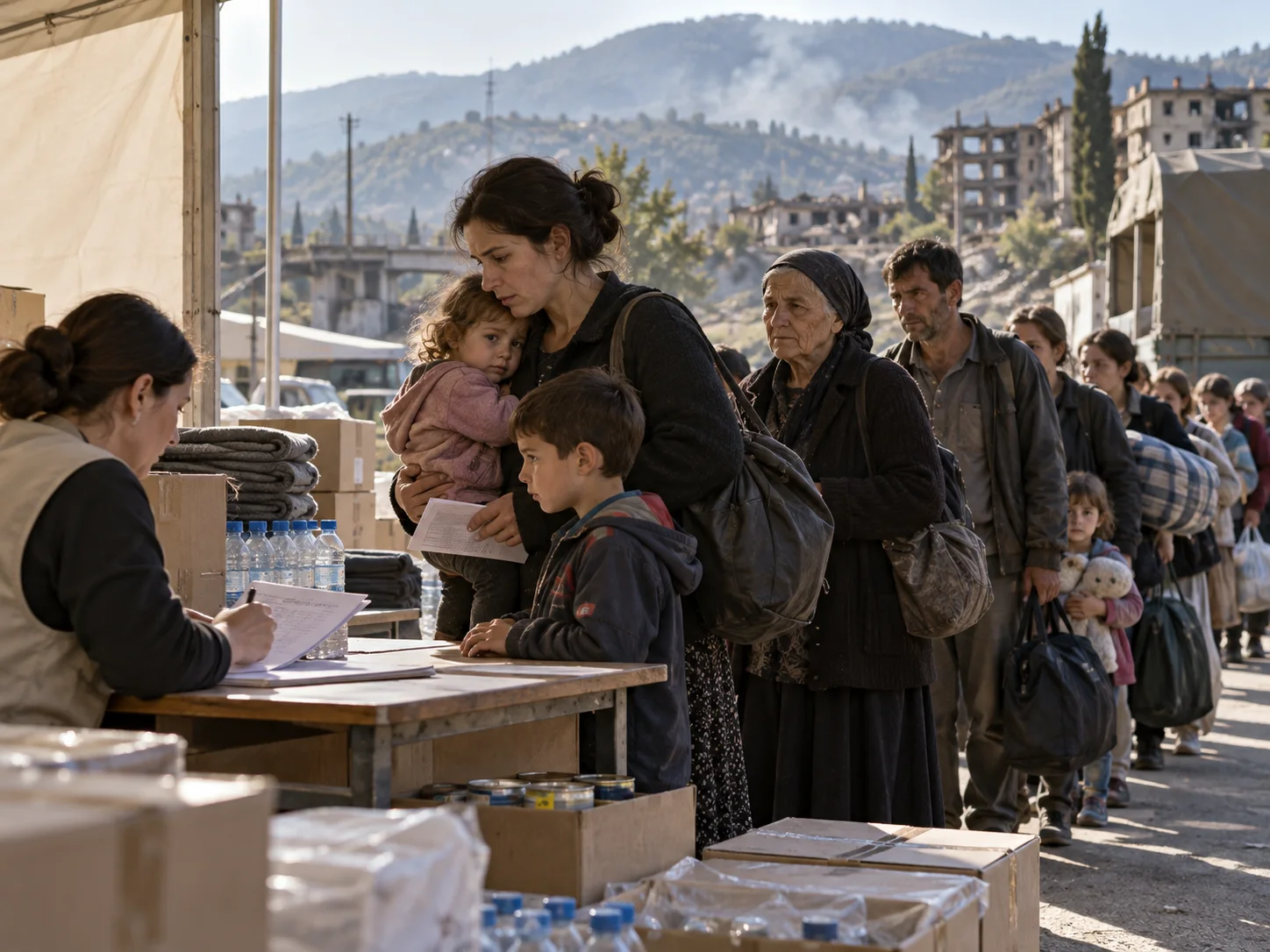
In August 2008, as war with Russia shook Georgia, people in the central city of Gori formed a line to receive food distributed by a church. A contemporary Guardian photo record explicitly describes people queuing for food in Gori on 15 August. For those who had fled fighting, and for residents who remained in the city, taking a place in line had become a practical route to the day's provisions.
The queue depended on an uncertain path for aid into the city. According to the photo caption, Russian troops allowed relief supplies through for the first time that day. UNHCR reported on 20 August that distributions had begun for thousands of people in western Georgia, combining WFP food with UNHCR blankets, kitchen sets and hygiene supplies. What waited at the end of the line was therefore not one commodity but several lifelines narrowed by war.
An Associated Press photograph from the same week also recorded Georgian women lining up for humanitarian aid in Gori on 18 August. The shape resembled an ordinary queue, but its order governed access to necessities made scarce by conflict. It documented both the arrival of assistance and the number of lives that had come to depend on it.