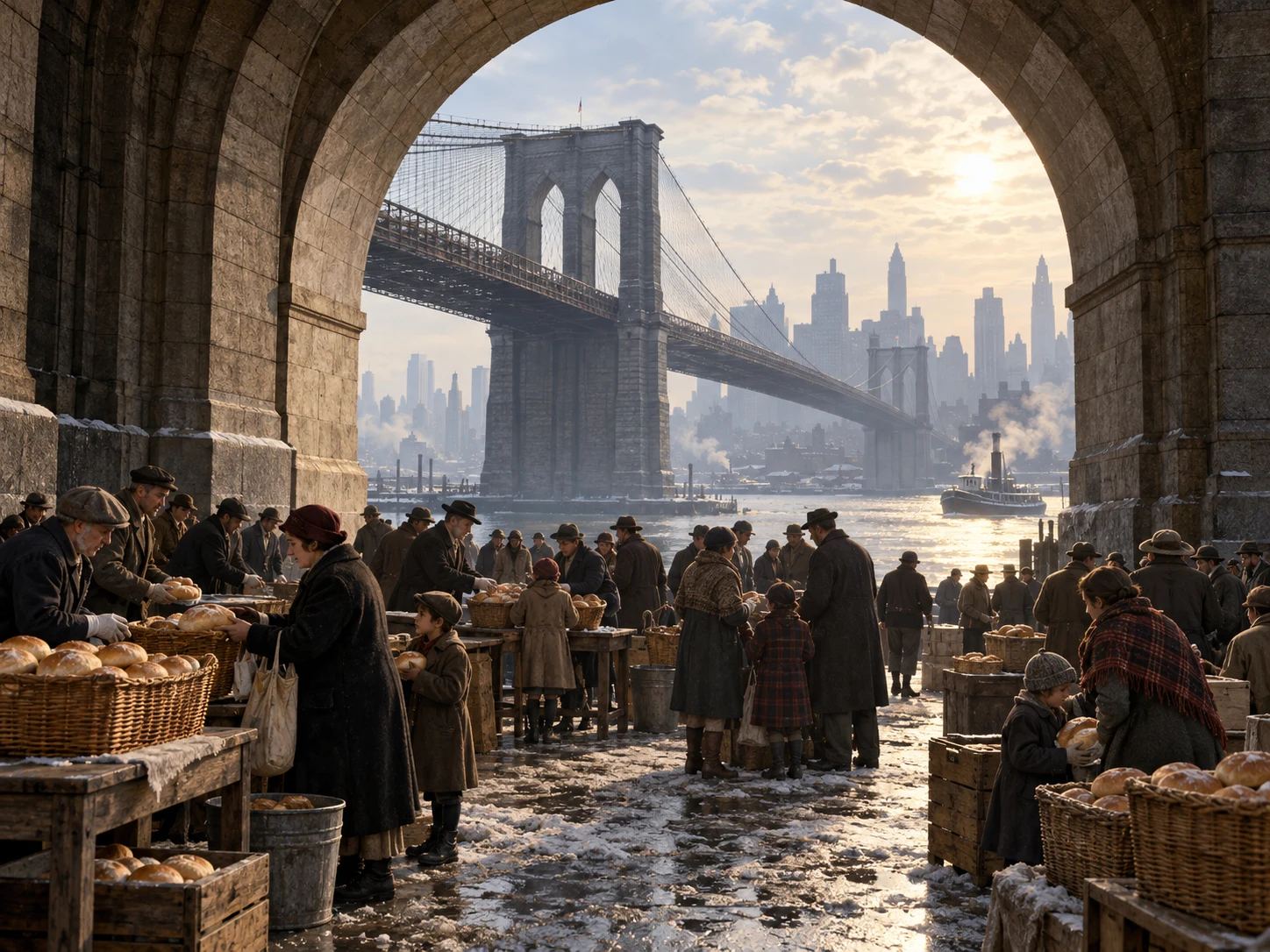
In the early 1930s, people formed a line for food beneath the approach to the Brooklyn Bridge in New York. The Library of Congress catalogue identifies the site as the McCauley Water Street Mission, dates the photograph to approximately 1930–34, and classifies its subject as bread and soup lines. This is not a later monument illustrating the Depression; it is a record of people actually waiting outside a relief mission.
After the 1929 stock-market crash, unemployment and lost income placed ordinary meals beyond the reach of many urban households. Before public assistance became extensive, churches, charities and private missions distributed bread and soup. At McCauley, recipients were not choosing among goods. They moved forward one person at a time according to the amount prepared and the speed of service.
The catalogue does not provide a headcount, duration or menu, so those details cannot be supplied as estimates. It does establish a striking contrast. Beneath infrastructure built to keep a metropolis moving, a narrow human line waited for the next meal. Trains, vehicles and commerce could still cross the city while food failed to reach all of its residents through ordinary markets.
The promise at the front of this queue was not economic recovery. It was one meal for that day. Under the Brooklyn Bridge, the vast abstraction called the Great Depression was experienced in a smaller unit of time: waiting until the person ahead had been served.