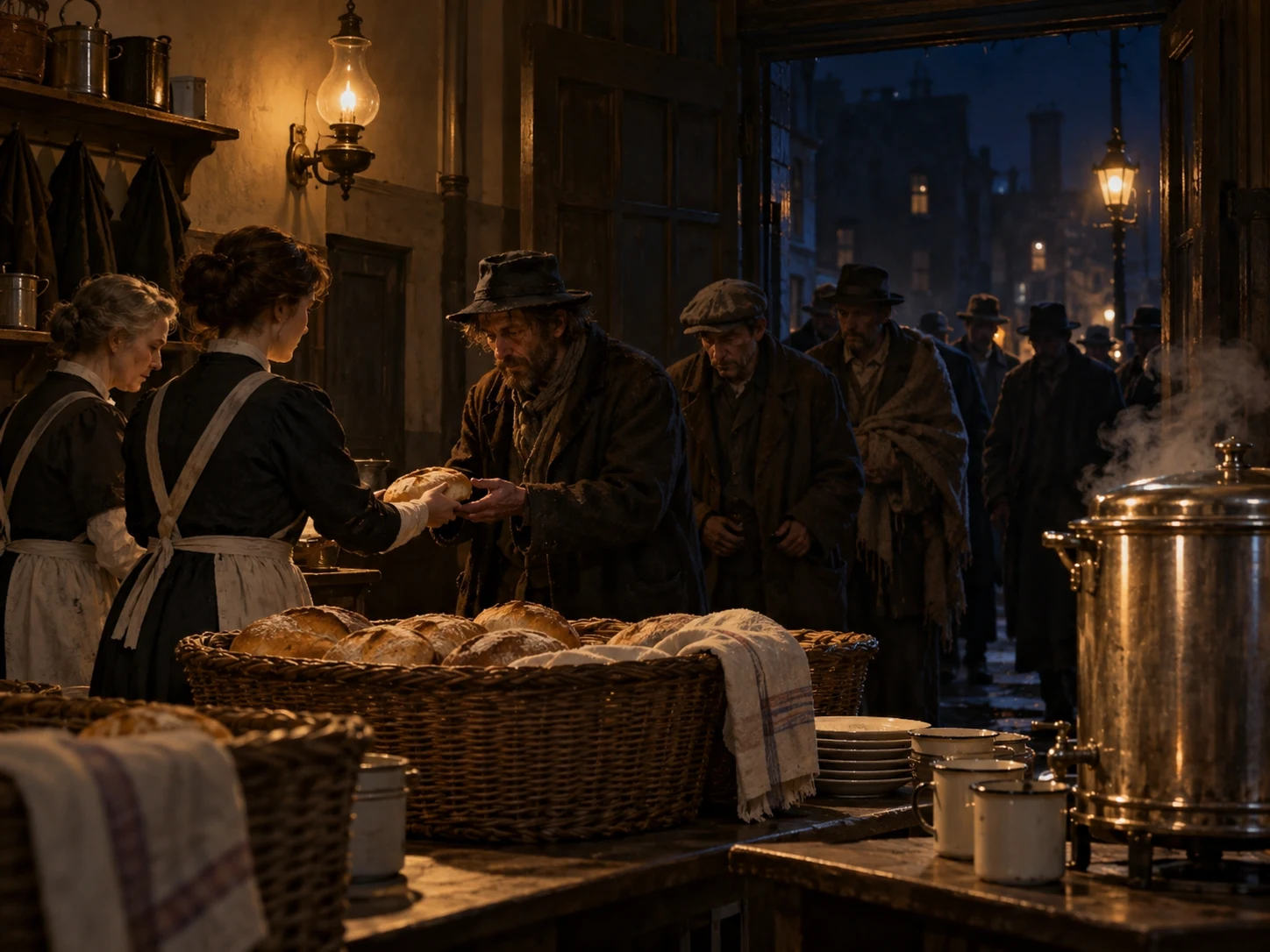
In 1907, photographer Lewis Hine recorded a bread line at the Bowery Mission in New York. The title preserved in the Library of Congress catalogue supplies an arresting time: 2 a.m. The archival description itself therefore establishes that a food queue existed not at a conventional breakfast or lunchtime, but deep into the city’s night.
Hine would become widely known for his photographs of child labour, but the facts securely attached to this particular record are narrower: New York, the Bowery Mission, a bread line, 1907 and two o’clock in the morning. The catalogue does not state the number of people, the amount distributed or each person’s circumstances. Those private histories are not assigned to the people in the line.
The hour nevertheless matters. A daytime queue usually follows the operating schedule of a shop or public office. A bread line at 2 a.m. shows that the time of need did not match the city’s ordinary business day. At its head was not a counter offering consumer choice, but food provided by a mission. That brief archival timestamp makes urban deprivation visible as a problem that crossed the boundary of the day: the order for receiving a meal continued while most of the city slept.