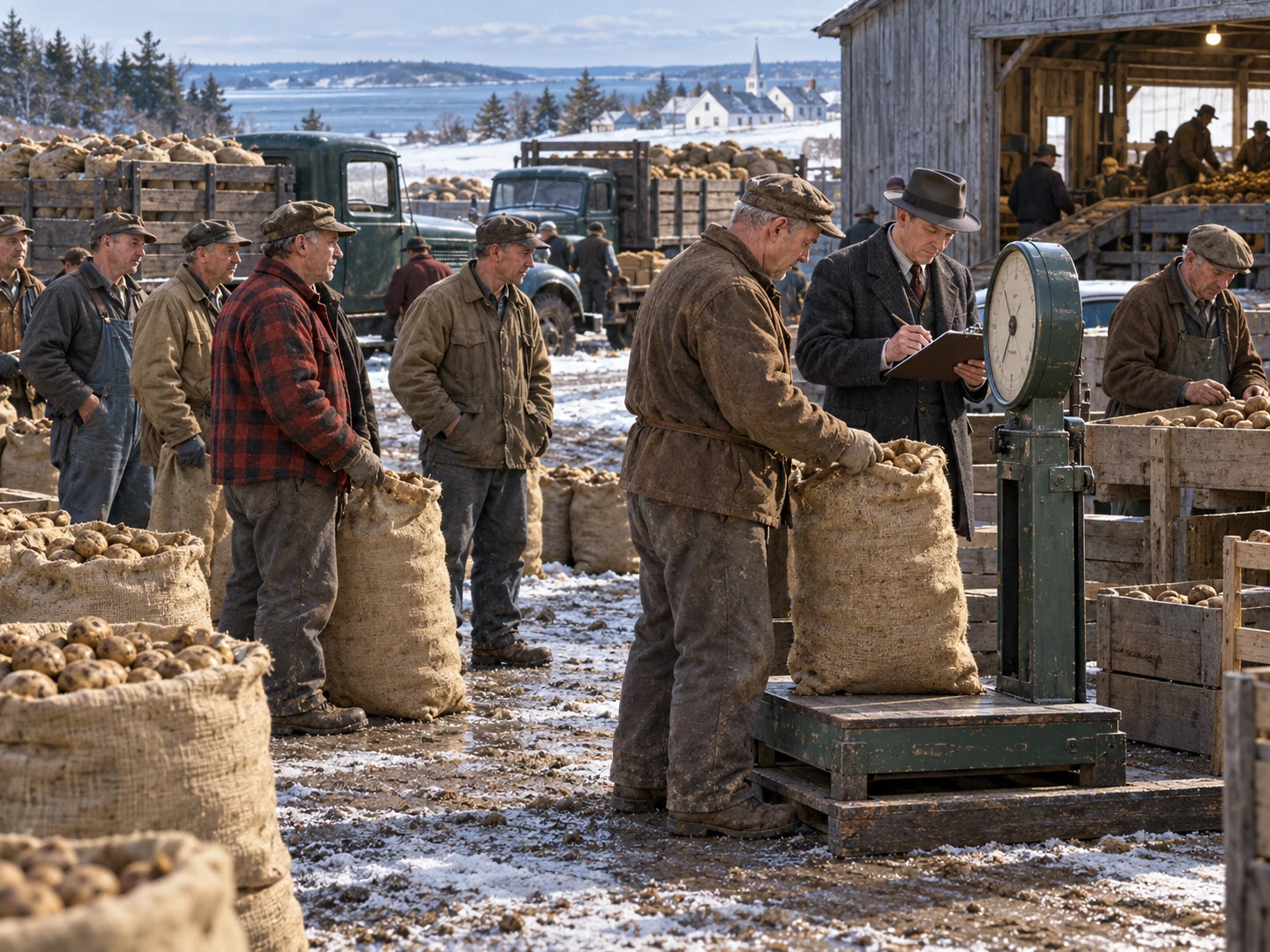
In October 1940, almost fifty trucks loaded with potatoes stood in line outside a starch factory in Caribou, Aroostook County, Maine. Jack Delano’s Farm Security Administration caption says that some farmers had waited twenty-four hours for their potatoes to be graded and weighed.
The people waiting were not customers trying to buy a scarce product. They were producers bringing in a harvest. Arrival at the factory did not complete the transaction: potatoes had to be assigned a grade and weighed before the accepted quantity and basis for payment could be established. When deliveries arrived faster than inspectors and scales could process them, a farm truck became a waiting place outside the plant.
Related photographs show a French-Canadian potato farmer awaiting his turn. The source says “almost fifty” trucks and that some—not necessarily all—had waited twenty-four hours, so the figures are not broadened beyond the caption. Even so, a full day in line shows how farm work continued after harvest. Potatoes became marketable industrial material only after passing, in sequence, through an inspector and a scale.